Saltar al contenido principal

Jódar

MUNICIPIOS
  • jódar
  • fd00355d-d748-a12a-b7ee-55f5181bf972?t=1595343295258
  • 030c38d0-26f7-b111-77a1-44b30528b2b3?t=1595343409514
  • 0f1d8f13-742b-a426-a9bd-2b7de31790f0?t=1595343444832
  • 63cff0aa-90d1-321d-c72d-cdf5ec8ec82d?t=1619531938975
  • 3c652ab6-a47e-0046-f798-ff8965c1ca52?t=1619531939033
  • d64f2f3e-b34c-f649-229a-d56dfa2face3?t=1619531939079
  • 6ad3041b-cdb6-901d-366d-7565b6d22278?t=1619531939122
  • jódar
  • fd00355d-d748-a12a-b7ee-55f5181bf972?t=1595343295258
  • 030c38d0-26f7-b111-77a1-44b30528b2b3?t=1595343409514
  • 0f1d8f13-742b-a426-a9bd-2b7de31790f0?t=1595343444832
  • 63cff0aa-90d1-321d-c72d-cdf5ec8ec82d?t=1619531938975
  • 3c652ab6-a47e-0046-f798-ff8965c1ca52?t=1619531939033
  • d64f2f3e-b34c-f649-229a-d56dfa2face3?t=1619531939079
  • 6ad3041b-cdb6-901d-366d-7565b6d22278?t=1619531939122

Description

A population belonging to the Sierra Magina region, located to the north-east of it, in a landscape composed of large extensions of olive trees on one side and saws on the other.

It is the most populated municipality of the region, its southwestern end is included in the Natural Park of Sierra Magina, which is part of the Subbetica and offers beautiful and spectacular landscape. The Guadalquivir, Jandulilla and the Arroyo de la Countess rivers go through their municipal term.

The cultivation of olive trees, asparagus and spartum-related crafts are part of their economic activity.

Among its artistic heritage are the Parish Church of the Assumption, the Muslim Castle, the Church-Sanctuary of the Christ of Mercy, the surroundings of the church, streets and squares where you can see traditional buildings of the region with its peculiar layout and the cave houses.

The Artistic Historical Set of Jódar has been in the cultural interest of Andalusia since 2014. Since 1983, together with the Castle and the Church of the Assumption, but the declaration as opened is from the Ministry of Culture.

Tourist Office

Museo de Jódar (Punto de información turística de Jódar)
Casa Municipal de la Cultura
Calle Juan de Mata Carriazo, 4. 2ª Planta - 1ª Puerta.
Tfno: 953 784 012
Web: www.saudar.com
correo@saudar.com 
Horario: De lunes a viernes, de 8 a 15 horas (verano: de 8 a 14 horas).
Domingos: De 11 a 13 horas.

Useful Information

Tourist area: Sierra Magina
Distance to the capital (km): 54
Altitude over sea level (m): 600
Extension (km ²): 149
Number of inhabitants: 11,667
Gentilicon: Galduriens
Postal code: 23500

Is part of

AUDIOVISUAL CONTENT

MORE INFORMATION

Culture

  • The Church of the Assumptionbuilt between the 16th and 17th centuries, of classical Renaissance façade and of great proportions. It has a Latin cross plant, with chapels among the contrasts. The deck is of canyon vault and dome on breast on the cruise. The presbytery, the major chapel and the cruise are 1775. The tower of the mid-17th century is decorated with episcopal shields and the neoclassical cover is one of the best in the province for its proportions. Located on the wall is the valuable "Ibero-Latin inscription of Galdur," mythological city and ancient cradle of Jódar, is from the 1st century BC
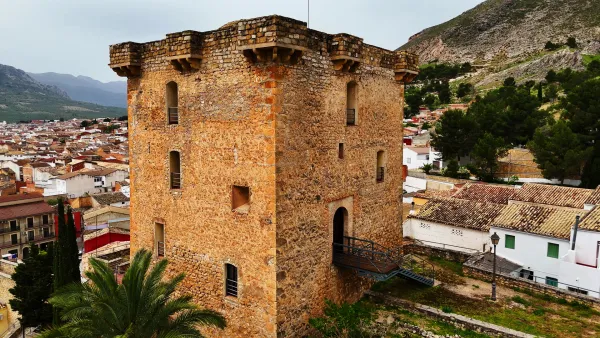
  • Jódar Castle. In the historical core of Jódar, on a rocky podium is the castle, mentioned in documents of 860. It is known that the castle is erected in Iberian times, as indicated by the inscriptions found in one of the armchairs, cthe most dean of the province and one of the oldest in Andalusia. It takes on importance in Muslim times with the Muladian revolts. This fortress has two towers of tribute, one of Arab origin and one raised by Christians. Both are almost square, in the Old Tower the entrance is located at the height of the first floor and has two series of saetera. The New TowerIt consists of a central wall and a central wall. Its saetries similar to those of the North Tower and the interior decks are vaulted vaults of the 16th century. It preserves mudejar stucco remains. Both towers have been restored. The South Tower is currently the Reception and Interpretation Centre of the Natural Park of Sierra Magina. The North Tower has been enabled to recreate and make known the history of the castle and the municipality.declared Historical Monument, under the protection of Good Cultural Interest, in 1985.
  • Sanctuary Church of the Christ of Mercy. It was built in 1700 on an ancient hermitage. It is of one ship and there is an extraordinary size of the 16th century of the Christ of Mercy. A baptismal stack of 1660 must also be highlighted.
  • Tower of the Pinars, declared Well of Cultural Interest, as Historical Monument in 1985. It sits at the southeast end of a hill that controls the right bank of the Jandulilla River, so its strategic position is beyond doubt. The tower is circular, with a door in height, which divides it into two bodies; the lower one is fully solid and the upper one has a small room also circular. It has an irregular masonry-based mating with plaster argamase, the same material that is used to cover the entire surface of the tower.

Nature

Jódar is located to the north-east of the Sierra Mágina region, in the skirts of the Cerro de San Cristóbal, belonging to its southwestern end to the Sierra Magina Natural Park. From here its territory descends to the Guadalquivir rivers and Jandulilla where the crop fields are given.

Half the territory is farmland in which the olive tree is the majority crop. In the vegas of the rivers, horticultural crops are produced and in the dry cereals.

Economic activity is based on olive groves and the olive industry, although it is raising high expectations for cultivation and industrial processing of vegetables.

The main altitudes of the term are the peaks Carboneras (1,511 m.), the saw La Golondrina (1,258 m.), Jodar's. (1,200 m.) and Altarillas (1066).

To the north of the municipality are the reservoirs bathing this area of the municipal term: Ms Aldonza, Pedro Marín and La Cerrada Bridge, and Natural area of Alto Guadalquivir, along with the river sections between them. Also declared as Special Protection Area for Birds (ZEPA); and Special Conservation Zone (ZEC).

In these mountains the Mediterranean vegetation in which the oak is frequent prevails. In the Vega del Jandulilla the sparthals abound, the result of the abandonment of cereal cultivation due to the scarcity of rains. In the course of the Jandulilla River, the tarays, alffas, common cane and canals are abundant between the main flora.

Of the fauna, the spartal birds, including granivorous birds such as the cogujada, the calandria, totovia and the common terra, draw attention.

  • Garden of the Cora:Located in the heart of the city centre, it is a unique garden that houses the recovery of more than 400 types of missing seeds and plants. It has formed a reservoir of mother plants recovered from extinction.
  • Hiking route the Pocco:From the peri-urban park of Traschatina is a marked hiking route called "El Pocico" that ascends through the skirt of the Sierrezuela de Jódar and has as its goal the hill of San Cristóbal, where one of the most wonderful views of the province, the valleys of Guadalquivir, Guadiana Menor and Jandulilla, or the Lomas of Ubeda and the saws of Cazorla and Magina, are seen, as well as an unparalleled view of the city.
  • Via Verde "El Paso" Y Barranco Del Cañaveral:Next to the old Royal Road to Granada, called "El Paso," you will find the Barranco del Cañaveral, a small gift splashed with alffas and juncos, in which ruins of several flour mills can be observed, including the call of Marcón, a true monumental relic. The area was splattered with watchtowers from the Middle Ages, on its wide road we found remains of industrial archaeology of the irrigation channel of the Jandulilla River, as well as one of the largest landlords in the area. The royal road ends on the Roman bridge of the Guadalquivir River, called "The old bridge" next to the ruins of "Ubeda la old."

Parties and Events

Among the most popular parties, they include:

  • Holy Week. Its origins are they go back to the 16th century. It is one of the most prestigious and rooted celebrations in Jódar. Currently is considered one of the most important and popular in the province of Jaén. It stands out for the quality of its sizes of famous imaginers and for the solemnity of its steps.
  • Festivals of Corpus Christi. The streets through which the procession passes are embellished with the ornaments of palm trees, banners with Eucharistic motifs, altars where the best joules and many others are displayed. The floor is rugged with joint, mastranzo and drawings made with colored sawdust. The Most Holy One goes in a magnificent step and in an overgold silver Custody of the year 1669.
  • Festivals of the Cross of May, 2 and 3 May. They are celebrated from the beginning of this century in honor of the Most Holy Christ of Mercy, pattern of Jodar. Two monumental arches of flowers are raised, popular altars with crosses also of flowers. The day 3 is held the procession of the Christ of Mercy that goes through most of the streets of the population, and after the end of the religious act, Christ returns to his hermitage.
  • Festivity of San Isidro, May 15. Every 14 May it is moved to San Isidro from its hermitage located in the "Fuente Garcíez" to Jodar. The following day, after the Eucharistic celebration, the Holy one returns to his hermitage, but accompanied by riders with chained horses, gilded reels for the occasion many rosemary who will spend the holiday between dances and singers taking as their stage the beauty of Sierra Magina.
  • Real September Fair. Founded by Royal Decree of Elizabeth II in 1837. As in Jódar, traders and farmers had no date to meet and be able to sell and deal with all genders, it was decided that the fair would be held on September 2.3 and 4. Today, many activities are planned, but we highlight their important bullfighting that have in sign the main taurine figures and the lively verbenas that are very busy.

Gastronomy

The gastronomy of Jódar is rich and varied, based on the products of the earth. We have to highlight the quality of your olive oil that enters as an ingredient in most of your dishes. We highlight those with the greatest roots:

  • Pipirrana. It is a salad with tomatoes, green peppers, onion, cucumbers, olive oil salt and tuna.
  • Gazpacho of the reapers. Warm stew based on chunks of cake and accompanied by meat from small game pieces, such as rabbit, perdiz or hare.
  • "The Morrococo." They are cooked chickpeas, tomato, onion, olive oil, salt and cumin.
  • Gachamas. Made of flour, water, olive oil, salt and potatoes. To accompany, longanize, pancake, chorizo...
  • Andrajos. flour cakes with tomato saffrito, onion, garlic, red pepper, and sometimes cod or rabbit.
  • The capers. Salted or curved capers that are taken as an appetizer mainly.

In pastry: The "twists," the wine roses, empanadas and chickpeas.

  • The "risol"is a traditional drink made of coffee, sugar, cinnamon, rose petals and spirits.

History

The human presencea in the vicinity of Jódar is documented from prehistory, being the site of The Quebrades the oldest known, dated towards the third millennium a. C.

The remains of the Ibero-Roman period, following the course of the Jandulilla River, including the funeral stone found in the old Villa Xandulilla or the Sphinx del Jandulilla located in Alamus cutamong others.

During Middle age the area remained heavily populated by Islamic settlements, with several alqueras and a castle shelter. In the 10th century it was considered an important urban core and noted oil producer.

About 1,229, the produces the Christian conquest of the city by the troops of Fernando III. From this moment on the town is growing in population and importance, so Alfonso X gives it the title of Villa Leal and the Fuero de Lorca.

During the 15th century it belonged to several owners, and the Catholic Kings created the Largest of Jodar, giving it to the Sanchez Day of Carvajal, his major guard.

The 16th century is prosperous and churches and buildings are built. The work of the spartum It also favours many of its inhabitants, on the contrary, in the following two centuries in which secular hunger, forced migrations and the terrible epidemic of the plague, which occurred in 1681, drastically reduce the population, which doubled in the 19th century and this caused problems, including the lack of housing and which many families moved to live in caves.

With the arrival of the railway and improvements in access, new migrants arrive, exceeding 10,000 inhabitants.

In 1919, Alfonso XIII, gives the villa thecity title, and to the City Council the treatment of Very impressive..

In this municipality

5

Accommodations

6

Events

We recommend