Between the Adelantamiento and the Sierra
This route invites you to explore the domains of two figures who changed the map of Jaén: the political power of Francisco de los Cobos, Imperial Secretary to Charles V, and the architectural genius of Andrés de Vandelvira. A journey from the golden stone of Úbeda to the crags of the Sierra de Segura.
-Torreperogil: The Echo of Knights on the Hill
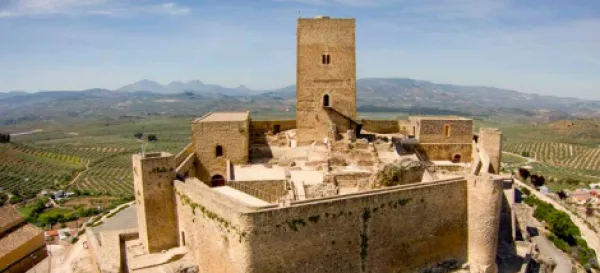
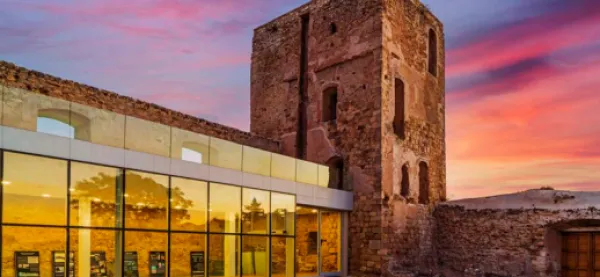
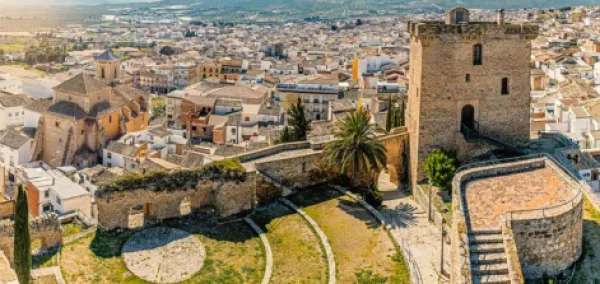
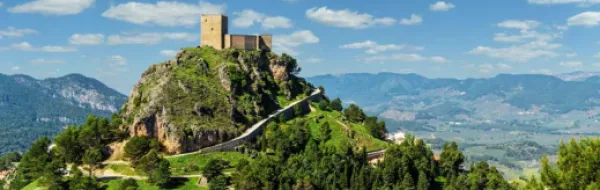
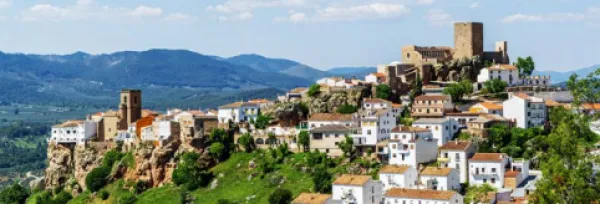
Just a stone's throw from Úbeda, Torreperogil appears on the hill as a town that has learned to coexist with its two souls: the medieval fortress and the Renaissance serenity. Upon arrival, the traveler perceives that blend of history and landscape that defines border towns. The Dark Towers: The two towers that still rise above the village are the guardians of that past. Their silhouette against the sky recalls the ancient fortress and the tales of knights who once gave the town its name. Church of Santa María: In the heart of the village, the Church of Santa María combines the sobriety of late Gothic with the clarity of an early Renaissance. Its portals herald a change of era, and in the Chapel of the Descent from the Cross, the stone altarpiece of 1571 displays the harmony that defined Vandelvira's style.
Hermitage of Mercy. In a tranquil corner, the Hermitage of Mercy surprises with a Baroque chapel where light falls upon the plasterwork, creating an intimate and delicate space.
-Peal de Becerro. Memory of stone and olive trees
Peal de Becerro is a place where history feels close. Among olive groves and gentle hills, the traveler discovers a municipality that has been home to civilizations since ancient times.
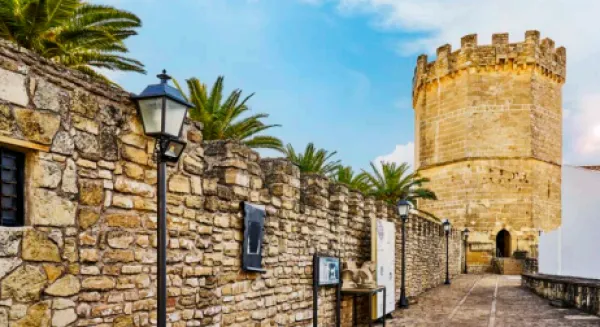
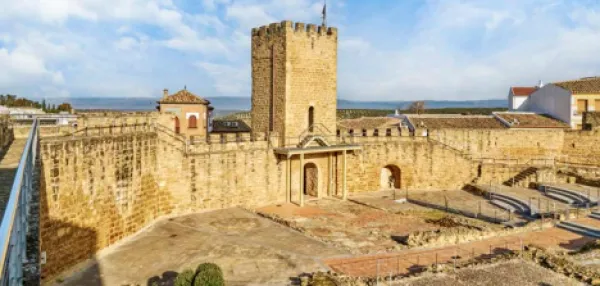
The Clock Tower and the Mocha Tower are the last vestiges of the fortress that watched over the Adelantamiento (district). Their presence recalls the strategic role that Peal played in the defense of the territory.
Just a few minutes from the village, the landscape opens up to reveal one of Spain's most important archaeological treasures: the Toya Burial Chamber, an Iberian hypogeum from the 5th century BC, which preserves intact the funerary architecture of a people who left their worldview here.
-Quesada. Light, mysticism, and landscape
The next stop is Quesada. Its historic center will guide you through narrow streets and medieval alleyways. A labyrinth of calm and beauty, where the Barrio de los Santos (Neighborhood of the Saints) transports us to a medieval village gazing at the mountaintop.
In Quesada, the gateway to the Sierras de Cazorla, Segura y Las Villas Natural Park, stands a building that is itself a work of art. The Rafael Zabaleta-Miguel Hernández Museum not only safeguards the legacy of the Quesada-born painter, but has also become a center of cultural pilgrimage, linking its destiny with the memory of the poet Miguel Hernández.
Rafael Zabaleta: The Color of the Earth: The museum houses the most important collection of the painter who captured the soul of Jaén. Zabaleta did not only paint peasants and olive groves; he elevated the landscape of Quesada to the category of universal art through a unique language that fuses expressionism with a luminous modernity.
Miguel Hernández: The Unceasing Verse: Since 2015, this space has housed the Miguel Hernández Legacy. Thanks to the poet's connection to Quesada (the birthplace of his wife, Josefina Manresa), the museum offers an intimate journey through his life and work. You can view original manuscripts, his personal correspondence, and the famous typewriter where some of the most courageous verses in our literature were born.
Among its religious architecture, the Church of San Pedro and San Pablo stands out, reflecting the influence of the Toledo Archdiocese on its design. Nearby, the Church of the Hospital preserves the sobriety of the Toledo tradition, adapted to the character of the mountains.
Quesada is one of the gateways to Spain's largest natural park: the Sierras de Cazorla, Segura y Las Villas. Its municipal area includes some of the park's most emblematic landscapes: Tíscar and the Cueva del Agua (Water Cave), a place where rock and water create a unique natural setting. In addition, there is one of the most emblematic archaeological sites in Quesada.
The Roman Villa of Bruñel, with its mosaics, allows you to imagine rural life between the 2nd and 5th centuries.
And the rock shelters with cave paintings, declared a World Heritage Site, remind you that... This territory has been home to art since prehistoric times.
Don't miss the Hermitage of Mercy, whose Baroque chapel will surprise you with the delicacy of its plasterwork.
-Peal de Becerro: Memory of Stone and Olive
A cradle of civilizations, Peal de Becerro is a must-see if you seek the deepest roots of our land. The Clock Tower and the Mocha Tower are the last sentinels of the ancient fortress that watched over the Adelantamiento.
Just two kilometers away, the silence of the countryside guards one of Spain's most important archaeological landmarks: the Toya Burial Chamber. This 5th-century BC Iberian hypogeum is a marvel of funerary architecture carved in stone, a direct journey to the origins of our culture.
-Cazorla. The city that opens up to the mountains
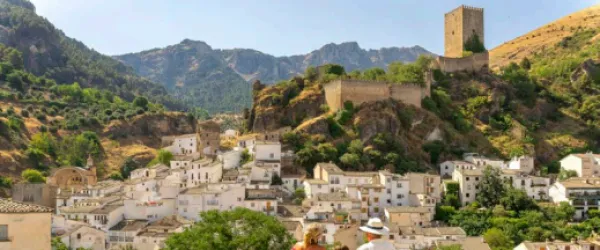
Cazorla appears to the traveler as a city that has grown with its gaze fixed on the mountains. Its history is marked by centuries of Toledo administration, by powerful lords, and by a landscape that shapes every street and every view. At the foot of the Sierra de Cazorla and bisected by the Cerezuelo River, the city unfolds in white terraces dotted with churches, convents, and the imposing Castillo de la Yedra, which dominates the neighborhood that bears its name. The Plaza de Santa María is the heart of the Adelantamiento. In the lower part, where the river flows hidden beneath a vaulted structure, a large plaza opens up, which was the center of Cazorla under the Adelantado Cobos. There stand the ruins of the Church of Santa María, a Renaissance temple. Its apse, clearly in the Vandelvira style, contrasts with the later elegance of the nave. Even in ruins, it retains a surprising beauty.
Nearby, the Fountain of Chains serves as a reminder of the importance of this space as a public square, alongside the old Town Hall, the butcher shops, and the headquarters of the Vicar of Toledo.
The Egg Square and the convents. In the upper part of town, the popular Egg Square—named for its shape—is the center of much of local life. Surrounding it is the Church of San José, the former church of the 17th-century Augustinian convent. Its Chapel of the Tabernacle, with its centralized layout and Baroque plasterwork, is one of the most unique spots in the city.
Nearby, the current Town Hall occupies the former Convent of La Merced, one of the most important in Cazorla, built in the 16th century and expanded in the 17th.
Walking up Calle del Carmen, you'll find the church of the former convent of the same name. Although it's known as Carmelite today, its origins are Jesuit: it was founded in 1589 by Doña Ana de Guzmán, daughter-in-law of Francisco de los Cobos.
The current church, designed by the Jaén-born architect Blas Antonio Delgado, showcases the religious architecture of the late 17th century. Its stone and brick tower preserves the Toledo tradition and may belong to the original structure.
Scattered across the hills surrounding the city are ancient medieval hermitages; from them, the views over Cazorla and Peña del Halcón are spectacular.
-La Iruela. A village clinging to the rock
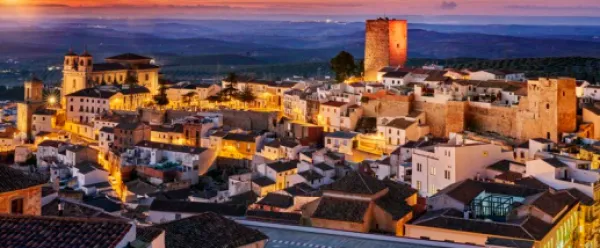
Just a few kilometers from Cazorla, La Iruela surprises you with its perfect integration into the landscape. The village embraces the mountain with a serene naturalness, as if it had been born from it.
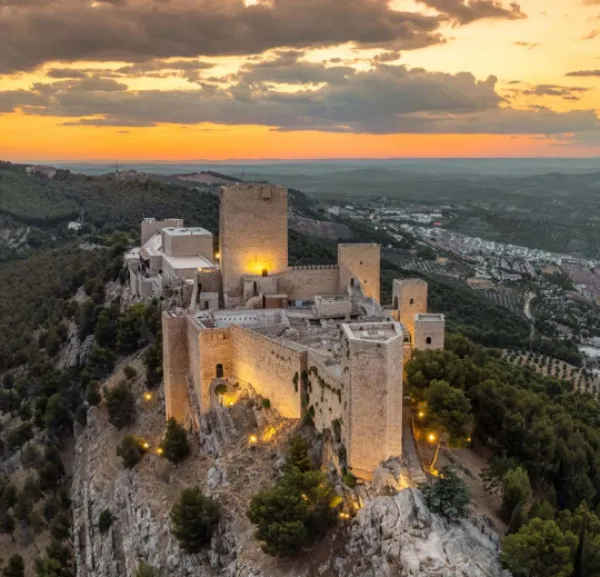
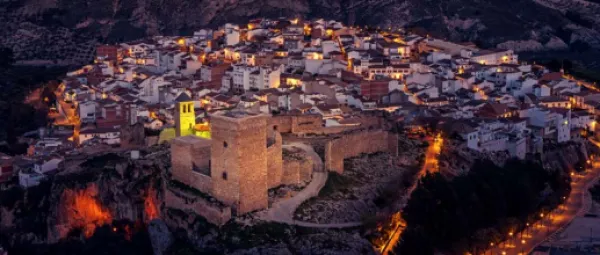
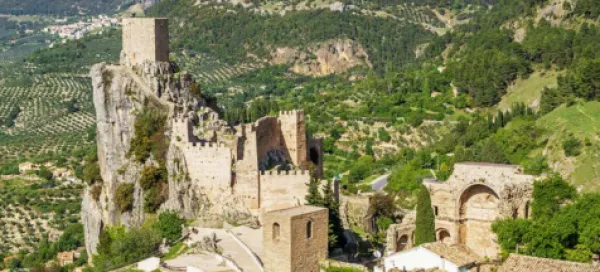
The village is dominated by an Almohad castle that rises on a rocky spur. Its presence is imposing: it seems to emerge from the stone itself. Within the enclosure are preserved the remains of the Church of Santo Domingo, a Renaissance work where some features recall the style of Vandelvira, although its design is more closely related to Rodrigo de Gibaja, an architect also present in Quesada.
From any point within the fortress, the views over the valley and the mountains are extraordinary. The main street, which runs through the entire town, leads to the parish church and the Town Hall, housed in the former 16th-century granary. Its vaulted silos, a documented work by Vandelvira, are one of the most unique elements of the local heritage.
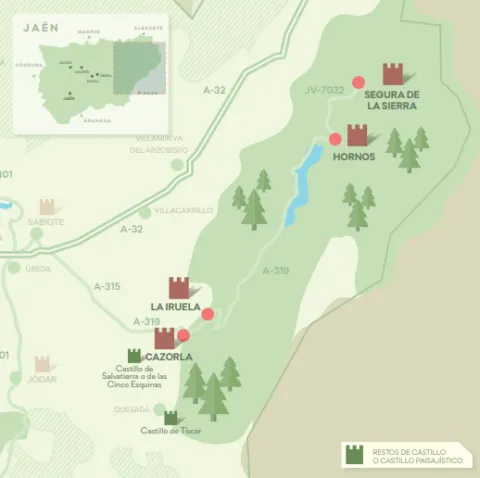
From La Iruela, you can access the heart of the Sierras de Cazorla, Segura y Las Villas Natural Park. At the Torre del Vinagre (Vinegar Tower), there is an interpretation center that will reveal the natural richness of the surrounding area.
Descending towards the Tranco Reservoir, the largest reservoir in the province, the landscape opens up towards the mountains. of Segura, and on one of its edges lies Hornos de Segura, the next stop on the route. -Hornos de Segura. The Time Lookout ...
-Segura de la Sierra. The Balcony of Heaven
Perched atop a legendary height, the former headquarters of the Order of Santiago is an enclave of breathtaking natural and monumental beauty. From its forests came the famous "Segura pines" used to build the Spanish navy and the most beautiful altarpieces in Andalusia.
The traces of an imperial past preserve an important heritage: the medieval castle, the Arab Baths, and the Fountain of Charles V, which proudly displays the Emperor's coat of arms.
You'll find the echo of Vandelvira in the Church of Santa María del Collado, which displays the master's style in its façade, while the former Jesuit College (now a cultural center) dominates the town with its architectural grandeur.
Segura de la Sierra is also a land of poets. Here you'll find the birthplace of Jorge Manrique; his presence in the Jaén region is documented at several key moments in the 15th century.
-Orcera. The Valley of Water
At the foot of Segura, Orcera welcomes you with its Church of Our Lady of the Assumption. A late Gothic church whose portal, rescued from the now-vanished Monastery of La Peña, is a marvel of delicacy. From here, you can explore isolated medieval towers that watch over the valley, or continue towards Siles and Benatae to discover the military architecture that defined this border region. -Beas de Segura. The Encounter with Mysticism On the edge of the Sierra, Beas de Segura links its name to that of Saint Teresa of Ávila. It was here that the Saint founded her first convent in Andalusia in 1575: the Monastery of San José del Salvador, a place of absolute serenity which, although rebuilt, maintains the typology and spirit of the Carmelite foundation. -Villanueva del Arzobispo. The northern gateway to the Adelantamiento Leaving Beas de Segura behind, the route returns to the historical territory of the Adelantamiento de Cazorla. At its northernmost point, four settlements emerged that shaped the life of these lands: Iznatoraf, Villacarrillo, Villanueva del Arzobispo, and Sorihuela del Guadalimar, known as the Four Towns.
The first town you'll encounter along the way is Villanueva del Arzobispo, nestled at the foot of the hill where Iznatoraf rises. It was dependent on Iznatoraf until it became a town in 1396. Nobly situated at the foot of the mountains, it invites you to a leisurely stroll past its landmarks of light-colored stone and ancient devotion:
The Church of San Andrés, a parish church of considerable size, was built throughout the 17th century. Its classical style reflects the legacy of the Jaén Renaissance, evident in the clarity of its volumes and the sobriety of its design.
And the Convent of Santa Ana, founded in 1540 by the preacher and writer Fray Domingo de Valtanás, a native of the town, this Dominican gem preserves the typology of female foundations, with its characteristic twin doorway. In the refectory, mural paintings from the late 16th century are preserved, adding a unique value to the complex.
The Sanctuary of Fuensanta, located on the outskirts, next to the N-322, is a religious space where the Virgin of Fuensanta is venerated, a devotion with a long tradition that even appears in the Cantigas of Alfonso X. Legend tells that the Virgin performed a miracle here, restoring sight and hands to a Moorish queen at the local spring. The medieval tower at its head recalls the building's ancient origins, although the interior was transformed at the end of the 17th century. - Iznatoraf. The Watchtower of Flowers Perched atop its hill, Iznatoraf, the oldest of the Four Towns, is a labyrinth of calm and beauty. Its Arabic name, "castle of the mountain," perfectly defines it. Imagine this town that seems to float above the countryside. A stroll through its streets is enough to understand: walls, gates, and a compact cluster of houses speak of its military importance. Conquered by Ferdinand III, it passed into the hands of the Archbishopric of Toledo, which administered it for centuries. Today, its memory unfolds serenely among olive trees and living stone: Church of the Assumption. The church's volume stands out above the surrounding houses. Built at the end of the 16th century, it shows the influence of Vandelvira in its hall-type floor plan covered with groin vaults, probably the work of his followers, perhaps Alonso Barba. The sacristy houses high-quality Renaissance chests of drawers, as well as valuable liturgical metalwork and textiles.
-Villacarrillo. The town that welcomed Vandelvira
Villacarrillo began as a hamlet dependent on Iznatoraf, until in the 15th century it obtained the title of Villa (town) thanks to Archbishop Alfonso Carrillo, whose name became linked to the toponym. Its cereal wealth fueled rapid growth during the 16th century, attracting master craftsmen and artisans, among them Andrés de Vandelvira, who established his first home here and acquired properties that forever tied him to the town.
Built on the site of the old medieval castle—whose remains are incorporated into the upper rooms, now a museum—the Church of the Assumption is one of the most important Renaissance churches in the Diocese of Jaén. Declared a National Monument in 1931, it combines Gothic elements in its pillars and side aisles with Vandelvira's spatial design, dominated by groin vaults.
The painted decoration of the vaults, the work of Pedro de Raxis, dates from the last quarter of the 16th century. The Baroque main altarpiece was created by Juan Gómez Lobo in 1670. The Chapel of Christ of the True Cross, with its Baroque niche, and the sacristy—where Alonso Barba worked—complete this exceptional ensemble.
On Vandelvira Street, number 7 is traditionally identified as the house where the architect lived during his time in Villacarrillo, where its streets weave history among olive trees and serene stone:
Feria Street brings together some of the best examples of domestic architecture: historicist palatial houses from the late 19th and early 20th centuries. Highlights include: the Palace of Cardinal Benavides, the Rubiales House, the old Courthouse, and the Youth Center. Further down, the 17th-century Regil House commemorates a family of stonemasons linked to the church.
On Repullete Street, the House of the Inquisition retains its original 16th- and 17th-century structure. Nearby, the Hospital of Santa Isabel, founded in 1645 by Bishop Moscoso Sandoval, boasts a church with a remarkable collection of Baroque paintings from the Granada school. -Úbeda, La Loma and Las Villas. A territory where the light of the Renaissance still shines. Úbeda welcomes you with the majesty of its walls, witnesses to a frontier past that in the 16th century was transformed into pure light. Birthplace of great statesmen, such as Francisco de los Cobos and Juan Vázquez de Molina, the city flourished under the pulse of modernity, becoming a cultural and political landmark that is now a World Heritage Site.
Today, Úbeda, together with La Loma and Las Villas, forms a territory where history, architecture, and landscape intertwine naturally:
Vázquez de Molina Square: A stage of glory. It is, without a doubt, one of the most beautiful squares in Europe. A space where Renaissance architecture reaches its highest expression of serenity and balance.
Sacra Capilla del Salvador: It presides over the square with a captivating elegance. Conceived as a funerary temple for Francisco de los Cobos and María de Mendoza, its initial design by Diego de Siloé was executed and enriched by Andrés de Vandelvira. *A masterful detail: Don't miss the Sacristy, where Vandelvira demonstrated his genius by designing a spectacular angled doorway, a technical and aesthetic marvel of the era. Dean Ortega Palace (Parador Hotel): Built for Hernando Ortega, a trusted advisor of the Cobos family, this palace is an example of sobriety and elegance. Its Renaissance courtyard invites you to pause and enjoy the tranquility of Úbeda. Palace of the Chains (Town Hall): Commissioned by Juan Vázquez de Molina to Vandelvira, this building is a masterful interpretation of the Roman house. Its bold and harmonious façade embodies the city's vibrant character. administrative center of the city for centuries.
The Footprint of a Genius. In Úbeda, Vandelvira didn't just build buildings; he designed an identity. The dialogue between the palaces and the Chapel of El Salvador creates an atmosphere of light stone that seems to absorb the sunlight and return it in golden tones at sunset.