Astroandalus, Viajes, Astronomía y Turismo Cientifico
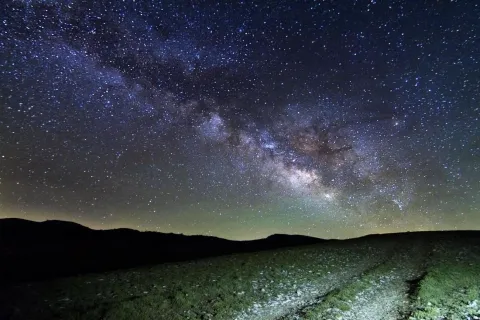
The South Sierra de Jaén, which obtained the Starligth Reserve certificate in 2014, retains the natural lighting and nocturnal conditions of the night sky intact. It is also a space where a commitment has been made to the defence of the quality of the night sky, access to the light of the stars and the different associated values.
The main building, about 70 square meters, houses the multi-purpose room and library, observatory control room, small kitchen, toilet and archive.
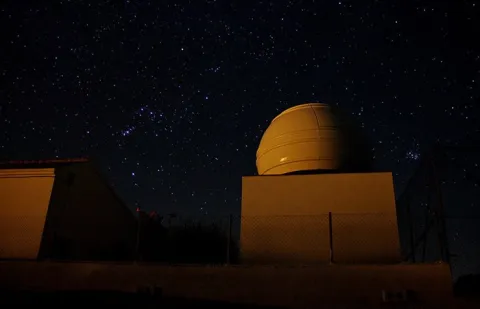
To the north of the main building and completely independent, is the observatory itself. The lower floor serves as a storage room for the various instrumentation and accessories of the telescopes and has a small workshop for the repairs.
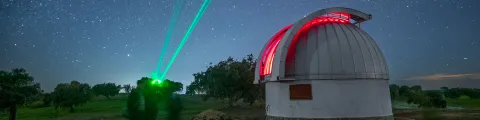
The 4-meter-in-diameter Scope Dome dome, installed on the top, has a Meade S / C LX200-ACF GPS telescope of 0.30 meters of opening at f / 10, in an equatorial fork mount, supported by an independent rigid column.
The whole of the Andalusian Observatory of Astronomy: Dome, telescope as well as its battery of accessories and instrumentation can be operated remotely from anywhere.
On the terrace of the control room there is a weather station specially designed for use in an astronomical observatory and an AllSky automatic camera for meteor detection.
In the village of La Pedriza, 8 km from Alcalá la Real with an impressive dark sky, the Einstein Society of Astronomy, with the collaboration of the Alcalá la Real City Council, has first-class facilities for astronomical observation and dissemination: the Andaluz Observatory of Astronomy.
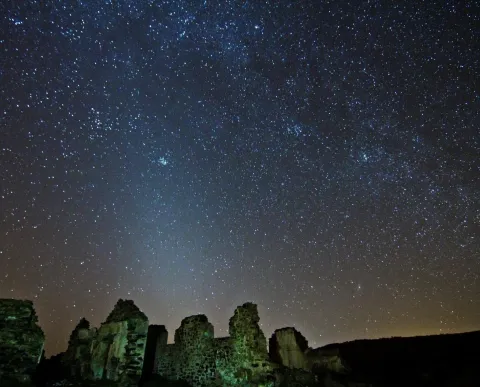
In spring it is possible to enjoy the elusive zodiacal light, while in summer it is an excellent place to observe the constellations that are being hidden in the West. Especially recommended to observe in group the different rains of stars that take place throughout the year due to their wide accessibility and the size of the explanade, where large groups can meet.
It is an excellent place to approach the family to enjoy the firmament on winter and spring nights. We recommend not to leave the explanade and not to go into the ruins under any circumstances for security matters.
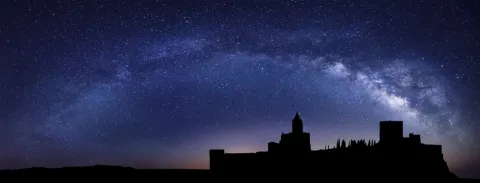
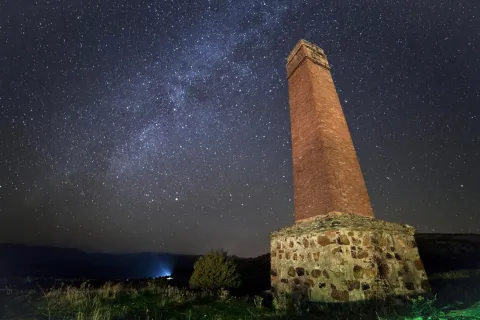
Few places are thought to be more appropriate for the observation of the firmament than the set of ancient mines abandoned from "El Centenillo," in Baños de la Encina, Jaén. Just 500 metres from this village in the west direction, we find a large explanade surrounded by old abandoned buildings. The horizon in the north, west and south direction is completely free of light pollution, with an impressive darkness in the cenit. This area is currently being restored.
To arrive there is only to follow the signs to the Natural Monument of the Quejigo del Master from Valdepeñas de Jaén, just 1 '5 km from a lane that descends to the right, continuing just over 2 km we arrive to an old ruined cortijo in the middle of a wide explanade.
The horizon is wide, although it is true that the mountains cut the celestial vault a little. We are facing a top-class place for those most demanding fans.
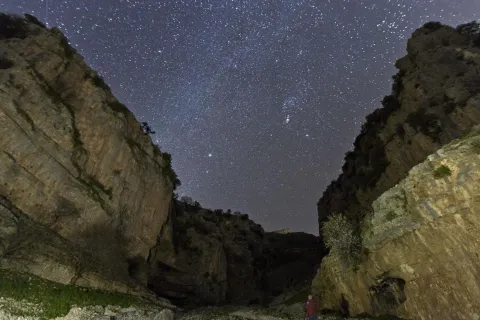
This observation point is located more than 1,100 meters in height and in the bottom of the valley with outstanding conditions of seeing and darkness.
We are at one of the best points in the entire Starlight Reserve in the South Sierra de Jaén. Note: the use of 4x4 vehicle is necessary to access this point, however it is worth it because it is reached at the bottom of a large valley surrounded by lomas and mountains that hide the few remains of light pollution. From this point on the darkness and purity of heaven is exquisite.
The point we propose in the old rear explanade of the old cortijo of Maria Luisa, right on the border between the provinces of Córdoba and Jaén, in the municipal term of Martos. It is easily accessed from the marteña pedanía of Monte Lopez-Alvarez in the direction of Albendín, a few meters from the province limit a detour to the left in the direction of Alcaudete. At this point is already visible the large line of cereal with the old cortijo preceded by a row of trees that is just the way of access.
In the back we find a large place to leave the vehicles and set up to enjoy the night show.
A nearby place for the inhabitants of the surrounding populations, easily accessible and wide to go on summer nights to enjoy the rain of stars. It is a place of wide horizon, very dark in the cenit and free of light pollution in much of the horizon. Only the light of Martos pollutes the horizons E and NE.
The access road runs through a relatively easy forest track; this track is taken from the same town of Marmolejo, after crossing the bridge over the Guadalquivir River at the height of the spa.
Right on the north bank of the river a right turn is taken towards the Aliseda, follow those signs and this way for 12.5 km until you reach the closed control door. There you can leave the vehicle and put things on the other side by entering the pedestrian door.
This point is especially suitable for those fans with telescopes and their own means in search of an outstanding sky and with light-taking to connect their equipment.
Another privileged place is La Cabrera Control, in Marmolejo. The great advantage of this enclave is that it currently has an electric current that can be taken directly from an external plug that is located on the wall of the guard's surveillance shed.
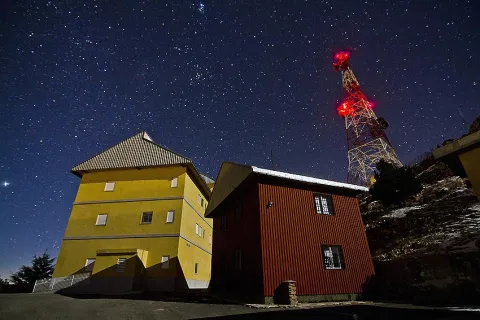
The northern horizon is impractical due to the proximity of the city of Jaén, however, looking east and south we find a true spectacle. It is a highly recommended place for those most expert fans who not only seek dark conditions but also good looking conditions, and is that at more than 1,800 meters high the atmospheric transparency is excellent, being one of the best points for planetary observation and photography.
To arrive there is only to take the detour on the road that links Los Villares with Valdepeñas de Jaén and ascend to the heliport, located on the top.
Note: some days of laminar air flow may occur in which case it is preferable to observe in the explanade that is next to the buildings rather than in the heliport.
The old military base of La Pandera is the highest point in the Starlight Reserve of the South Sierra de Jaén and an emblematic place for the observation of the firmament. At its top there is a great explanade where in the past there have been important remains of astronomy fans that brought together hundreds of people.
The village of Los Guindos, in the town of La Carolina, has a spectacular north and west horizon, where on winter nights it is possible to observe the elusive zodiacal light.
Especially recommended in the autumn and winter months with the arms of Perseus and Orion hiding in the west.
With easy access and very close to the A-4 motorway, we are facing a magnificent enclave from which to enter into the wonders of the universe within the framework of the Reserve and Starlight Tourist Destination of Sierra Morena.
The ancient mining complexes in the northern province of Jaén are magnificent observation sites, the presence of ancient mineral loading and discharge structures offer the possibility to install our telescopes in large, barrier-free vents.