

Description
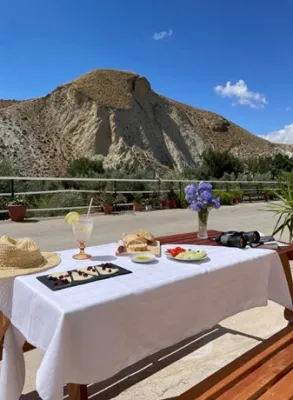
We will not know all the wealth of the vegetation of the Park without visiting the semi-arid areas of its southern end. They are hard, unwooded landscapes, with an extreme climate of very high temperatures, but that hardness is overcome by the beauty of its landscapes, its colors and its vegetation that is extraordinarily interesting by the number of unique species in the territory it houses.
These semi-arid areas are the result of the gradual degradation of the ancient Mediterranean forest, which with an aridization of the climate has sculpted landscapes whose beauty is only overcome by their hostility and dryness, causing the plants to pass hard tests in order to live in these environments.
This vegetation is called xerophyll, because it lives in dry environments, with precipitation below 300 mm. annual. Among them are species such as albaida (Anthyllis cytisoides), sosas or salsoles (Salsola oppositifolia), salates (Suaeda spp., Hammada articulata), herb of the conjunctures (Ephedra fragilis), garbancers (Ononis fruticosa) and rabbit garbancillo (Ononis tridata). At times there are sabinas (Juniperus phoenicea), rosemary (Rosmarinus officinalis), male rosemary (Cistus clusii), rethemes (Retama sphaerocarpa), tomilos (Thymus zigis), some carrasco pine (Pinus halepensis) and some other lenticus (Pistacia lenticus), reminding us that this vegetation is the result of the destruction of an ancient Mediterranean forest.
But one of the most significant species of these areas is the caparra (Capparis spinosa), a culinary plant that its preparation in vinegar has been known from very old, and is now an essential element in the best European kitchens.
We suggest:
- The best times for this visit are in autumn and early spring.
On this trip we will not spare the car. We will head to Huesa and from there we will take the road of Pozo Alcón and follow it to the crossing that leads us to the village of Ceal. From this village comes a narrow and tortuous road that goes to Hinojares, which passes through a semi-arid area, populated by scavenges (Stypa tenacissima), which in the area has the name of an atocha, so a nochar is a spartal.
Is part of

near here
We recommend