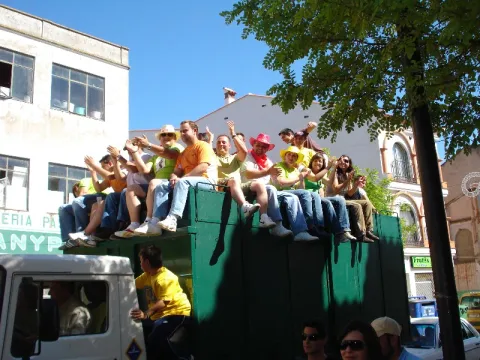
Saltar al contenido principal
icon-intereses-cultura

Holy Week in Sabiote

Submitted by brandcode_deweloper on
Id
8103448
Redes sociales
Instagram
https://www.instagram.com/semana_santa_sabiote/
Descripción
Breve descripción

During Holy Week, Sabiote brings its religious works of art out onto the streets to commemorate the Passion of Christ and his sacrifice for the salvation of humankind. Its origins date back to the mid-16th century, with the founding of the Brotherhoods of Nuestro Padre Jesús Nazareno around 1550, that of Nuestra Señora de la Soledad, and that of the Santísimo Cristo de la Expiración before 1561. Later, the Brotherhood of the Santo Entierro was created in 1636, followed by the Brotherhood of Cristo Resucitado before 1669. Given these historical roots, our Holy Week is comparable in age, splendour and devotion to those of Andalusian capitals such as Seville, Córdoba or Málaga.

The town of Sabiote has been shaped by the rich brotherhood culture found throughout Spain. Thanks to the men and women of this town, the indelible mark of devotion to the brotherhoods has been preserved.

Our Holy Week grows year after year, offering an artistic spectacle, both for the quality and value of its carvings, and for the music of its bands, distinguished by their Nazareno musicians, dressed in the tunics and costumes of their brotherhood, performing beautiful compositions and processional marches.

Each brotherhood has its own particular character and features, as is the case with the Brotherhood of the Nazareno, whose departure in the early hours of Good Friday from the Church of Santa María, when "El Miserere" is performed, moves all those present.

Six brotherhoods carry out their Station of Penance during Holy Week in Sabiote, with eleven Pasos to admire the beauty of the religious imagery, metalwork, carvings, embroidery and more.

Among the sculptors, Palma Burgos stands out, who shaped the figures of San Juan Evangelista and Santa Verónica.

We are grateful that hundreds of people work throughout the year to make Sabiote a meeting point for brotherhood devotion, for the enjoyment of both our own townspeople and all those who visit us.

Telecomunicaciones
Sitio web
https://sabiote.com/fiestas/
Ubicación
Latitud
38.069192
Longitud
-3.306813
Municipio
Ubicación en el mapa
POINT (-3.306813 38.069192)
Imágenes
imagen
Image
semanasanta_Sabiote.jpg
Imagen principal
Activado
Horario de apertura
Semana Santa
Evento anual (=Periodicidad)
Activado
Tipo de evento
Loading map
Preparing points of interest and routes...
Interés

Fiestas del Medievo

Submitted by brandcode_deweloper on
Id
11871211
Descripción
Breve descripción

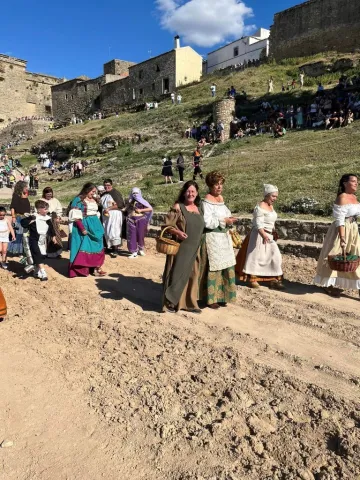
Sabiote relives the splendour of the Renaissance, decorating its castle of the Order of the Knights of Calatrava. Streets and squares become a  great stage full of music, dance and performances. Horses are the other great stars of the festivities, thanks to their well-known races. 

Ubicación
Código Postal
23410
Latitud
38.068491
Longitud
-3.310877
Municipio
Ubicación en el mapa
POINT (-3.310877 38.068491)
Imágenes
imagen
Image
fiestas%20medievo.jpg
Imagen principal
Activado
Horario de apertura
Mayo
Evento anual (=Periodicidad)
Activado
Tipo de evento
Loading map
Preparing points of interest and routes...
Interés

Fiesta de Mozos

Submitted by brandcode_deweloper on
Id
1003451
Descripción
Breve descripción

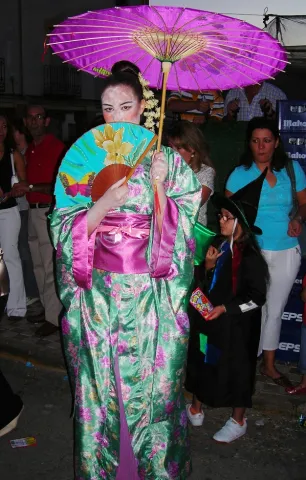
On the second-to-last Sunday of September, Rus celebrates the Fiesta de los Mozos, which has its origins in an outbreak of bubonic plague that devastated the town, killing most of its young people. Tradition holds that, to fight the epidemic, residents carried the Blessed Sacrament in procession, and that as a result, the sick began to recover. To commemorate this miracle, the Blessed Sacrament is carried in procession every year as if it were Corpus Christi Day, while at the same time a carnival is held — a truly unusual occurrence at this time of year — recalling the masks under which the young men used to hide their faces so that death would not recognise them, allowing them to outwit it.

The Fiesta de Mozos of Rus is the town's most popular and historic tradition. So much so that, since 30 November 2018, it has been recognised as a Festival of Tourist Interest in Andalusia by the region's Ministry of Tourism and Sport.

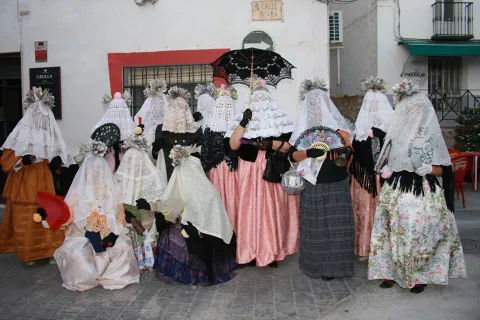
The Fiesta de Mozos of Rus is unique in the world, since alongside a second procession of the Blessed Sacrament, held with the same solemnity as the traditional Corpus Christi, the townspeople dress in all kinds of masks expressing wit, mockery or criticism on the part of those wearing them.

For three days, everyone who wishes to take part dresses in traditional masks and costumes, intended to pay tribute to the moment when the town endured the cruelty of these epidemics. However, it is also very common to let the imagination run free and cover the face with more modern costumes, sometimes, as mentioned, carrying a message of irony, protest or mockery.

Telecomunicaciones
Sitio web
https://rus.es/fiestas/
Ubicación
Código Postal
23430
Latitud
38.047980
Longitud
-3.464034
Dirección
Plaza de la Constitución, 1
Municipio
Ubicación en el mapa
POINT (-3.464034 38.04798)
Imágenes
imagen
Image
fiesta_mozos_rus.jpg
Imagen principal
Activado
Fecha Inicio
21 Sep 2026 00:00
Fecha Fin
21 Sep 2026 00:00
Evento anual (=Periodicidad)
Activado
Tipo de evento
Loading map
Preparing points of interest and routes...
Interés

Feast of San Antón

Submitted by brandcode_deweloper on
Id
7154299
Descripción
Breve descripción

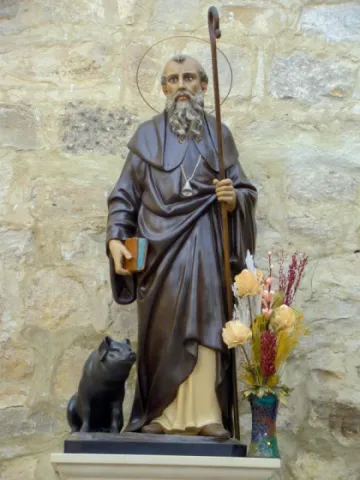
The feast of San Antón is one of Rus's traditional festivals: the «Bonfires of San Antón» on the night of 16 January, the San Antón omelettes and hot chocolate, the churros, and the traditional «aniseed cigarettes» rolled by toasting aniseed and mixing it with tobacco to keep it lit, then smoked around the bonfires together with family, friends and neighbours into the early hours, often ending up grilling chops and chorizo over the embers.

On 17 January, the feast day of San Antón, a Eucharist is celebrated in his honour, after which all the animals brought along by their owners are blessed.

Telecomunicaciones
Sitio web
https://rus.es/fiestas/
Ubicación
Código Postal
23430
Latitud
38.047673
Longitud
-3.461804
Municipio
Ubicación en el mapa
POINT (-3.461804 38.047673)
Imágenes
imagen
Image
san_anton.jpg
Imagen principal
Activado
Fecha Inicio
16 Jan 2026 00:00
Fecha Fin
17 Jan 2026 00:00
Evento anual (=Periodicidad)
Activado
Tipo de evento
Loading map
Preparing points of interest and routes...
Interés

Feast of San Blas

Submitted by brandcode_deweloper on
Id
7154367
Descripción
Breve descripción

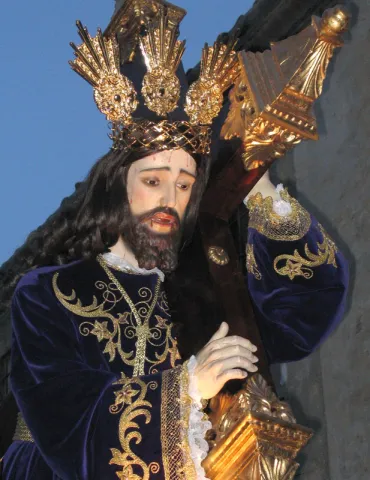
Bishop and martyr, who died in the year 316. Accounts of his life and martyrdom date back no further than the 9th century, though they are not entirely without foundation, and the liturgy has echoed them. Ragusa, Taranto and other cities claim to hold relics of the saint, who was one of the most popular figures of the Middle Ages. According to legend, he was a physician in Sebaste, a profession in which he became known for the miracles that accompanied his cures. When the episcopal see of that city fell vacant, he was raised to that office. However, shortly afterwards he withdrew into solitude in a cave, where he lived as an austere penitent, until the servants of Agrícola, prefect of Cappadocia, acting in the name of Emperor Licinius, discovered him, his dwelling surrounded by numerous wild beasts. Imprisoned, Licinius made great efforts to win him over to paganism. All in vain; he was beheaded along with seven women. In many places, his feast day is marked by the blessing of two candles, placed in the shape of a cross, held over the heads of the faithful and touched to the throat, since he is invoked against throat ailments — because, on his way to prison, a mother brought him her son, who was choking to death on a fishbone, and San Blas cured him. Bread and salt are also blessed for the healing of illnesses in people and animals, as is oil, into which the candle wick is dipped. Wool carders regard him as their patron, because before he was beheaded, his flesh was torn with an iron comb. In Russia he is the patron of livestock, since large numbers of wild beasts would go into the desert to his cave so that he might bless them. He is depicted holding two crossed candles in one hand, with an iron comb, with the child from whose throat he removed the bone, with a pig (which a wolf had snatched from a woman, and which was returned to her by the Saint's order), or, finally, in the cave surrounded by beasts of the forest. The Eastern Church honours him on 11 February; the Latin Church on 3 February.

The Order of San Blas was a military order from Armenia, founded in the 12th century, both to promote the worship and religious life of the faith and to fight the Mohammedans through its members. It ceased to exist when the Turks conquered Armenia. The knights of this order wore a blue costume with a golden cross, at the centre of which was the image of San Blas.

According to popular tradition, the Feast of San Blas in Rus has always been the town's biggest festival, being held in honour of its Patron Saint: the «Patron of the Charcoal Burners». Such was the devotion to their patron saint that men would leave their work in the mountains to come and spend this festive day with their families.

This was the festival of fireworks and Cocido con Relleno. Decades ago, when there was little money because wages were very low, men would save throughout the year, secretly setting aside a small fund ("matute") hidden from their wives, in order to buy fireworks to set off on the day of San Blas, in his honour: it was quite a sight to see San Blas carried in procession through the streets of Rus amid the smell of gunpowder.

When fireworks became more sophisticated (quite a few years ago now), it was rather spectacular to see, in the final firework wheel, an image of San Blas appear. The town hall square was packed with people, and everyone was amazed, shouting ¡¡¡Viva San Blas!!! and applauding wildly.

The Diocese periodically reassigns parish priests among our towns, and on one such occasion when it was Rus's turn to have a new priest, there was great surprise in the village when the newcomer, a few years later, declared that San Blas was not the Patron Saint, but the Co-Patron. The true Patron Saint was Santiago. And that San Blas was not a charcoal burner either, but a physician. That he was made a saint for saving a child who was choking on a fishbone, by feeding him a piece of bread ring. This is how the famous rosquillas de San Blas began to be made in Rus as a tradition.

As every year, on 3 February Rus dresses up in celebration in honour of its Co-Patron Saint San Blas. This eagerly awaited festival for the people of Rus begins on 2 February with the Hoguera de la Candelaria bonfire, held in the town hall square. In this bonfire, bundles of "ramón" (olive branches) are burned, cut and brought to the village by the Brothers of San Blas.

On 3 February, the main day begins at eight in the morning with the flower-decked Diana. This involves the Municipal Music Band, accompanied by the Brothers of San Blas, setting off fireworks through the streets of our town while shouting VIVA SAN BLAS.

At 11:30 am, the religious festival in honour of our Co-Patron Saint begins, at the end of which the members of the brotherhood hand out the rosquillas.

After the rosquillas have been handed out, San Blas is carried in procession through the streets of our town, accompanied by all the people of Rus. In some years, the Civil Guard band from the Academy in Baeza has also taken part.

Once the procession ends, it's time for the "Ligá", going from bar to bar drinking beer and wine with the corresponding tapas. Afterwards, some finish up at local restaurants, while others follow tradition by eating the typical Relleno at home.

The afternoon continues with coffee and more time spent celebrating in the town's bars, waiting for the fireworks display.

A few years ago, on 4 February (SAN BLASILLO DAY), a day of recovery and rest, a few last fireworks could still be heard, signalling that the end of the festivities began at five in the afternoon with the "Rateros" (small firecrackers thrown along the ground), with the brothers gathering once more to throw them and dodge them to avoid getting burned, ending with a Grand Traca (string of firecrackers) marking the end of the Feast of San Blas until the following year.

Telecomunicaciones
Sitio web
https://rus.es/fiestas/
Ubicación
Código Postal
23430
Latitud
38.047673
Longitud
-3.461804
Municipio
Ubicación en el mapa
POINT (-3.461804 38.047673)
Imágenes
imagen
Image
shutterstock_216504511.jpg
Imagen principal
Activado
Fecha Inicio
02 Feb 2026 00:00
Fecha Fin
04 Feb 2026 00:00
Evento anual (=Periodicidad)
Activado
Tipo de evento
Loading map
Preparing points of interest and routes...
Interés

Fiestas de los Mozos

Submitted by brandcode_deweloper on
Id
11880709
Descripción
Breve descripción

One of the most deeply rooted popular festivals in Rus. A unique and singular celebration, unlike any other in the province or indeed the whole country, marking both Corpus Christi and Carnival twice a year. Its origin lies in the great plagues and epidemics that struck this part of the province in the 17th century, mainly affecting young people. According to oral tradition, residents implored the Blessed Sacrament, which they carried out in a rogation procession so that the epidemic would end — and from that moment, no further infections occurred. The young men who survived decided to celebrate by wearing disguises, giving rise to the tradition of carrying the Blessed Sacrament in procession in September and warding off death with “mascarillas” (masks). 

Ubicación
Código Postal
23430
Latitud
38.048181
Longitud
-3.461267
Municipio
Ubicación en el mapa
POINT (-3.461267 38.048181)
Imágenes
imagen
Image
DSCN0458.JPG
Imagen principal
Activado
Fecha Inicio
18 Sep 2026 00:00
Fecha Fin
20 Sep 2026 00:00
Evento anual (=Periodicidad)
Activado
Tipo de evento
Loading map
Preparing points of interest and routes...
Interés

Festivities in Honour of the Patron Saint, the Virgen de Tíscar

Submitted by brandcode_deweloper on
Id
8103737
Descripción
Breve descripción

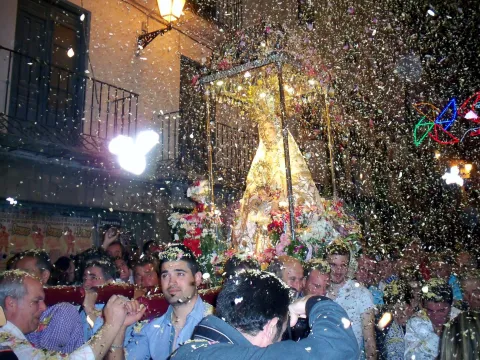
During these days, all kinds of activities take turns until the moment the Patron Saint leaves the Church of San Pedro y San Pablo to return to the Sanctuary of Tíscar, where she will remain until the first Saturday of May the following year, when the pilgrimage is held once again to bring her back to Quesada.

Telecomunicaciones
Sitio web
http://www.quesada.es/
Ubicación
Código Postal
23480
Latitud
37.845288
Longitud
-3.067648
Dirección
Plaza de la Constitución, 1
Municipio
Ubicación en el mapa
POINT (-3.067648 37.845288)
Imágenes
imagen
Image
Tiscar_quesada.jpg
Imagen principal
Activado
Fecha Inicio
23 Aug 2026 00:00
Fecha Fin
29 Aug 2026 00:00
Evento anual (=Periodicidad)
Activado
Tipo de evento
Loading map
Preparing points of interest and routes...
Interés

San Sebastián

Submitted by brandcode_deweloper on
Id
8103613
Descripción
Breve descripción

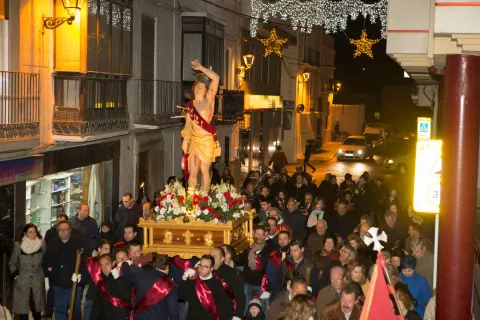
Between 19 and 21 January, festivities are held in honour of San Sebastián, patron saint of Quesada. On the 19th, the saint is brought from his hermitage into the town, so that the following day, three flag-bearers and the drummer, dressed in old-fashioned costume, perform five flag displays during the afternoon procession of the image. The day ends with the luminaria (bonfire) lit in front of the Town Hall door, where cured pork products and wine are enjoyed. The festivities close on the 21st, which differs from the previous day only in that the flags are danced three times.

Telecomunicaciones
Sitio web
http://www.quesada.es/
Ubicación
Código Postal
23480
Latitud
37.845288
Longitud
-3.067648
Dirección
Plaza de la Constitución, 1
Municipio
Ubicación en el mapa
POINT (-3.067648 37.845288)
Imágenes
imagen
Image
sebastian_quesada.jpg
Imagen principal
Activado
Fecha Inicio
19 Jan 2026 00:00
Fecha Fin
21 Jan 2026 00:00
Evento anual (=Periodicidad)
Activado
Tipo de evento
Loading map
Preparing points of interest and routes...
Interés

Summer Festivities

Submitted by brandcode_deweloper on
Id
8103934
Descripción
Breve descripción

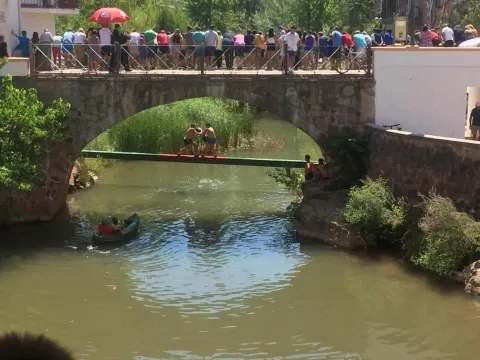
Held on the last weekend of August, also known as “Fiesta del Emigrante”, aimed at celebrating the reunion with family and friends living outside their hometown. During the celebrations, lively open-air dances are held, although the highlight is the “water greasy pole” competition held on the Guadalimar river.

Telecomunicaciones
Sitio web
http://www.puentedegenave.es/
Ubicación
Código Postal
23350
Latitud
38.353533
Longitud
-2.804346
Dirección
Av. Andalucía, 11
Distrito
Municipio
Ubicación en el mapa
POINT (-2.804346 38.353533)
Imágenes
imagen
Image
cuca%C3%B1a_puente.jpg
Imagen principal
Activado
Fecha Inicio
14 Aug 2026 00:00
Fecha Fin
14 Aug 2026 00:00
Evento anual (=Periodicidad)
Activado
Tipo de evento
Loading map
Preparing points of interest and routes...
Interés

Festivities in Honour of San Isidro

Submitted by brandcode_deweloper on
Id
8104084
Descripción
Breve descripción

The Town Hall organises sporting competitions and numerous cultural activities, one of the main attractions being the “release of young bulls”, which draws large numbers of visitors from neighbouring towns.

Telecomunicaciones
Sitio web
http://www.puentedegenave.es/
Ubicación
Código Postal
23350
Latitud
38.353533
Longitud
-2.804346
Dirección
Av. Andalucía, 11
Distrito
Municipio
Ubicación en el mapa
POINT (-2.804346 38.353533)
Imágenes
imagen
Image
sanisidro_puente.jpg
Imagen principal
Activado
Fecha Inicio
15 May 2026 00:00
Fecha Fin
15 May 2026 00:00
Evento anual (=Periodicidad)
Activado
Loading map
Preparing points of interest and routes...
Interés