La Campiña Route
A Journey Through the Golden Light of the Guadalquivir
When you enter the Campiña of Jaén, the landscape opens up like an old book. The land is flat and generous, and the Guadalquivir crosses it with the calm of one who knows all its secrets. Here, among wheat fields and olive groves, the Renaissance left a mark that can still be found today in quiet squares, proud towers and temples gazing towards the horizon.
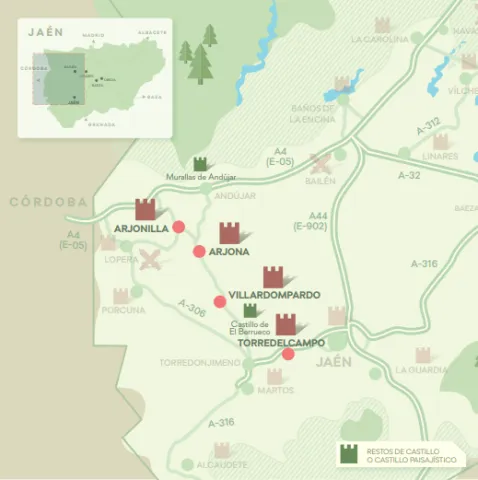
This route takes you through cities that grew to the rhythm of trade and craftsmanship, places where everyday life mingled with the grandeur of a new age. Andújar, the most powerful of them all, welcomes you with the elegance of its churches and the strength of its history. Lopera, Porcuna, Arjona and Arjonilla complete a mosaic of towns where Renaissance architecture coexists with the intensity of the Baroque that followed.
Master craftsmen who shaped the 16th century worked in these lands. Vandelvira's influence can be sensed in details and layouts, but it was Francisco del Castillo "El Mozo" and his brother Benito del Castillo who gave form to many of the buildings you see today. They were joined by craftsmen and architects from Córdoba, leaving behind an artistic landscape full of nuance.
On this route through the Campiña, you will come across towns holding stories of frontier life, nobility and faith. It means pausing at a Renaissance doorway glowing in the evening light, listening to the echo of an old market, or discovering how the light settles on a tower that has watched over the valley for centuries.
Mengíbar: Where History Keeps Watch from Above
Arriving in Mengíbar, your first impression is shaped by its Torre de Homenaje, a stone giant rising more than thirteen metres above the village. It is the last remaining trace of the medieval castle and still seems to guard the secrets of these lands, where the legendary Roman Iliturgis once stood, on the nearby Cerro Maquiz.
At the foot of the tower, the Church of San Pedro reveals the mark of the Renaissance. Its interior, with three naves and groin vaults, follows the model that Vandelvira spread throughout the province. Although the church was completed after his death, his architectural spirit still lives on in every pillar.
Walking along Calle Jaén, you'll come across the so-called Casa de la Inquisición, with a late Classicist doorway and ironwork worth a closer look. These are details that speak of a prosperous Mengíbar, linked to the Guadalquivir and its old river port, from where timber coming down from the Sierra de Segura once departed.
From here, the route opens up towards the Campiña. You can continue towards Andújar or take a detour towards Bailén, with its Church of La Encarnación and its history linked to the famous battle of 1808.
If you choose this variant, a short detour will take you to Baños de la Encina, where the imposing Caliphate castle dominates the horizon. Its Renaissance palace-houses and the Church of San Mateo complete a striking monumental ensemble. And in the Ermita del Cristo del Llano, the Baroque camarín — a burst of polychrome plasterwork and mirrors — will surround you with unexpected beauty.
Cazalilla: A Small Stop with Medieval Soul
A few kilometres from Mengíbar, Cazalilla appears as a quiet village that preserves traces of its old fortress. What remains is a semicircular tower, now built into the Church of La Magdalena, whose Gothic interior and Renaissance renovations tell centuries of history. The Classicist doorway and its tall tower from 1627 complete a simple ensemble full of character.
Villanueva de la Reina: The Village that Always Looked to the River
In Villanueva de la Reina, you meet the Guadalquivir once again, here accompanying a village with Roman roots — the ancient Noulas — and a medieval past still visible in its layout. Its Church of the Immaculate Conception preserves Gothic arches and pillars, transformed in the 17th century with an elegant Classicist doorway and a tower crowned by a beautiful spire.
Facing the church, the Town Hall also displays the strength of the Renaissance in the Campiña, with a gallery of arches and a late-16th-century doorway. A further Classicist doorway from the Hermitage of San Nicolás has been incorporated into its façade, adding a historic touch to the ensemble.
Andújar: The Great Gateway to the Guadalquivir
In Andújar, you feel you are in the natural capital of the Campiña. The Guadalquivir has embraced it for centuries, and its history unfolds through wide streets, bright squares and temples that speak of a powerful past. It was a frontier city, a city of trade and craftsmen, and it experienced one of its brightest moments during the Renaissance.
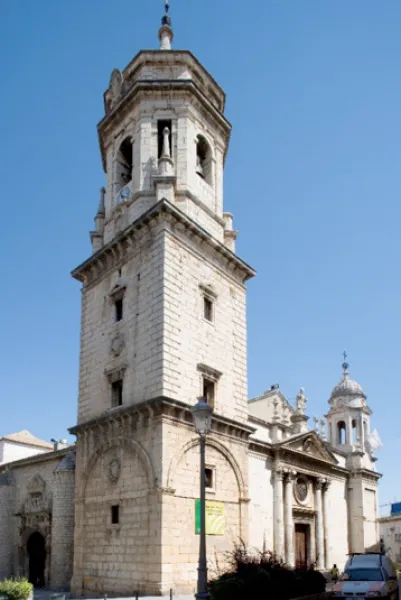
The monumental heart of the city beats around the Church of Santa María la Mayor, where Gothic and Classicist styles coexist naturally. Nearby, the Casa de Comedias, the old Pósito (granary) and the Renaissance doorways scattered throughout the historic centre recall the city's prosperity in the 16th and 17th centuries. The mark of master builders such as Castillo "El Mozo" and his brother Benito appears in details, layouts and architectural solutions that define Andújar's identity.
Its noble houses, churches and old city gates speak of a city that grew to the rhythm of trade and the river. And in its surroundings, nature asserts itself strongly: the Sierra de Andújar, one of the great sanctuaries of the Iberian lynx, offers a landscape that contrasts with the serenity of the Campiña.
Marmolejo: Waters that Tell Stories
Following the course of the Guadalquivir southwards, you come across Marmolejo, a village that has always lived in dialogue with the river. Its medicinal waters, famous for centuries, gave life to a renowned spa that even inspired Palacio Valdés in the film "La Hermana San Sulpicio." Here, the thermal tradition is part of the landscape.
In the historic centre, the Church of Nuestra Señora de la Paz stands out for its sober elegance. Its Classicist doorway, typical of the 17th century, hints at an interior that has been renovated but is full of detail, such as the two 18th-century Baroque altarpieces that arrived from Benavente.
On the outskirts, the Bridge over the Guadalquivir, with its seven stone arches, stands as one of the most spectacular works along the river. It was built by Benito del Castillo in the late 16th century. Its harmony and strength will surprise you.
Within its municipal boundaries, the Castillo de la Aragonesa recalls the area's medieval past, later transformed into a grand estate with a Neoclassical chapel.
Lopera: A Castle Guarding Centuries of Memory
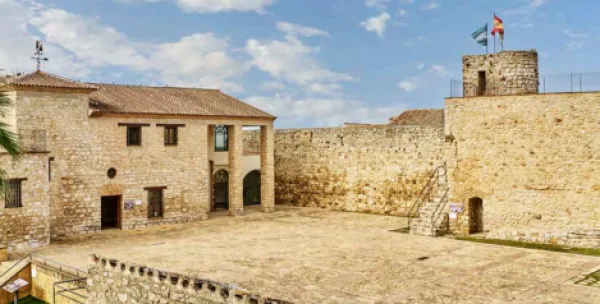
Leaving Marmolejo and heading west, the landscape leads you to Lopera, a village that grew under the protection of a powerful castle. Right in the town centre stands its late-medieval castle, once a fortress of the Order of Calatrava and today a Historical Monument. Its walls, once a noble residence, hold the calm of places that have witnessed many lives and many battles.
Facing it, the Church of Santa María — or de la Purísima Concepción — shows the transition from late Gothic to the Renaissance. Inside awaits a jewel: the Renaissance tomb of Doña Marina Fernández de Torres, the work of the Jaén sculptor Juan de Reolid, delicate and solemn, attached to the wall as if it wanted to become part of the architecture itself. Among its Baroque altarpieces, some Granada-school paintings and 18th-century goldwork add brilliance to the ensemble.
The Town Hall, although rebuilt after the Civil War, retains the sober monumentality of the 17th century, reminding you of the historical importance of the place.
Porcuna: Where the Past Emerges Like a Sculpture
Porcuna welcomes you as a place where the past surfaces at every step. The ancient Iberian Obulco left behind treasures such as the sculptures of Cerrillo Blanco, and the medieval city later rose around the Torre Nueva, or Torre de Boabdil, today a museum and symbol of its history.
In the Plaza de Andalucía, the Church of the Asunción combines its Renaissance sacristy with a Neo-Romanesque nave decorated by a young Julio Romero de Torres. The Town Hall, housed in the former 18th-century Pósito, completes this monumental space. Nearby, the Convent of San Benito preserves medieval capitals and doorways that recall the legacy of the Order of Calatrava.
A pleasant stroll leads to the Ermita de Nuestro Padre Jesús, with its Baroque camarín, and to the striking Casa de Piedra, built entirely of stone by local stonemason Antonio Garrido over almost thirty years.
And if you want to experience the more intimate side of Porcuna, simply head to La Calderona, one of the most distinctive archaeological sites in the municipality, known for its rich Iberian and Roman remains.
Arjona: The Hill Where a Dynasty Was Born
Arjona rises on a hill overlooking the Campiña and holds a history as deep as it is fascinating. It was the ancient Roman Urgavo, later a stronghold of the Order of Calatrava, and later still the birthplace of the Nasrid dynasty that ruled Granada. In the 17th century, it once again rose to prominence with the discovery of the relics of the martyr saints Bonoso and Maximiano, which turned the city into a place of pilgrimage.
The heart of Arjona beats in the Plaza de Santa María, where centuries of history converge: a large Arab cistern, the Church of Santa María — Gothic with Baroque additions — and the Sanctuary of the Martyrs, a late-Renaissance work by Juan de Aranda Salazar, with its crypt and 18th-century camarín. Around it, five 17th-century wrought-iron crosses are still preserved, witnesses to the old pilgrimages.
In the lower part of the town, other churches show the evolution of the Renaissance in Arjona. The Church of San Juan preserves an early Granada-Renaissance doorway and a surprising Modernist crypt built for the Baron of Velasco. The Church of San Martín retains its Renaissance tower with a ceramic-tiled spire, the work of Castillo "El Mozo." And the Neo-Gothic Church of El Carmen recalls 19th-century devotion.
Arjona will reveal its Nasrid past through architectural details and public buildings where a very distinctive Neo-Nasrid style emerges.
You can reach Arjona from Porcuna either via the direct route or by passing through Higuera de Calatrava, where the Church of the Purísima Concepción surprises with its twisted Renaissance pillars, before continuing on to Arjona through open fields and quiet villages.
Arjonilla: The Tower that Guards a Legend
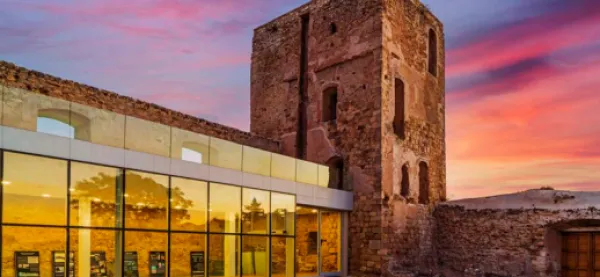
Just eight kilometres from Arjona lies Arjonilla, a town that was born as an independent lordship in 1553 and which literature remembers for the tragic story of Macías "El Enamorado," imprisoned and killed in its castle. Of that Calatrava fortress, what remains today is the Torre de Macías, rising over the town as a symbol of love and destiny.
Nearby, the Church of La Encarnación shows the transition from Gothic to the Renaissance: medieval pillars and arches, a highly Vandelvira-style Doric doorway, and a Classicist tower linked to the style of Castillo "El Mozo." Inside, a surprising Visigothic altar stone used as an altar, 16th-century mural paintings and a valuable collection of Baroque goldwork await you.
In the small square of Santiago, the Ermita de la Virgen de la Cabeza preserves a splendid 16th-century Mudéjar coffered ceiling, while on the outskirts, the Ermita de la Soledad recalls Vandelvira-style models such as the one in Andújar.
Arjonilla also preserves a good number of 18th-century noble houses and an elegant Courthouse building, the former 17th-century Town Hall, reflecting the sober Classicism of the late Jaén Renaissance.
Lahiguera: A Quiet Hilltop in the Campiña
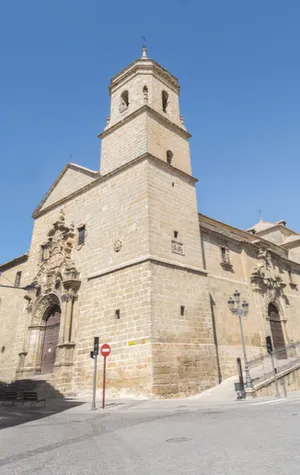
On the way to Jaén, and before returning to Arjona, you come across Lahiguera, a serene town set on a gentle hill overlooking the landscape. Its silhouette is defined by the Church of La Consolación, an early-16th-century temple that preserves the simplicity and harmony of the area's earliest Renaissance buildings.
It is a single-nave church, covered with a Mudéjar-style tie-and-collar-beam roof, a detail that adds warmth and authenticity. Its presence, sober and elegant, sums up well the character of Lahiguera.