



Description
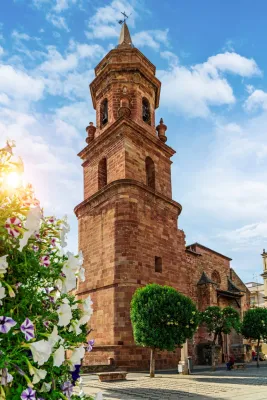
Monument included in the Artistic Historical Set. Incoated on 09 / 07 / 82. Old Bajomieval parish. It presents in its constructive process such evolution to the close of Santa Maria, keeping in the temple architectural and decorative elements Gothic, Renaissance and Baroque
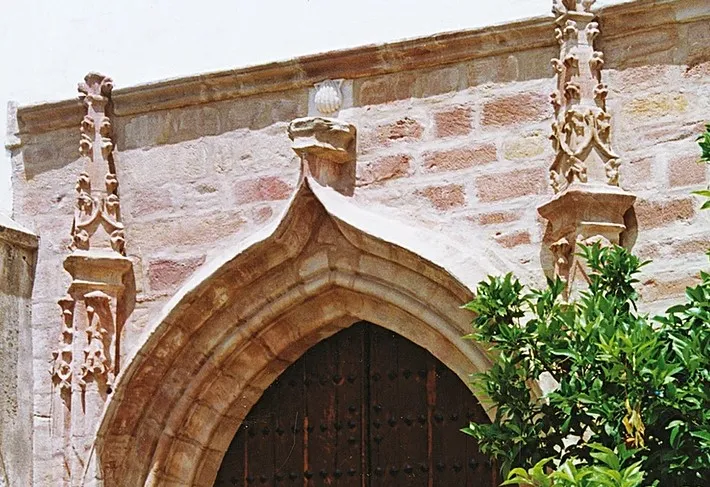
The oldest piece is the southern cover, of Gothic style and of such a trace to that of San Miguel; the north is from the 17th century, with the shields of the Valenzuela family, raising on it an angry swordsman, which came to replace its primitive tower located at the head and from which there are no remains. The plant that has reached this day includes a division in three ships and five sections, with greater proportions being the section of the header and the central ship. Today it has no apse, its head being a wall running and flat. The oldest remains correspond to the first section, covered by three gothic vaults of complex trace and a great constructive stretch (starry the sides, of tercelets the central), which are based on two pillars free of square section, with four half Tuscan columns attached, and on a series of mends on the walls. It is in this part of the temple that we can relate the few documentary data that have been published about it. The Gothic vaults according to Domínguez Cubero can be attributed to the Sunday of Tolosa. In 1559, the bishop Don Diego Tavera (1555-1560) ordered in the visit of this temple: "(...) that the altarpiece of Miguel Ruiz be finished. They say that the altarpiece is finished and that the work of singing that is in charge of Maese Domingo (...)." In the same year I know "(...). They discharge a thousand four hundred and ninety-six maravedis that I pay to Baldenvira because he came from Jaén to give the trace of the work that to do the said Sunday master who came three times to see the work (...)." From this documentation it seems to be inferred that the temple initiated by Maese Domingo is visited by Vandelvira, which would give new traces to follow the factory based on pillars of siloesque tradition and boned vaults. This new church project must have had problems years after the intervention of Andrés de Vandelvira, as it appears from the will of the beneficiary Juan de Mestanza of 1585, in which he orders to deliver ten ducats "(...) for the work of the postcards of Lord Santiago (...)," in the opinion of Domínguez Cubero. As a result of this situation, the project drawn up by Vandelvira, in which a church of living room with exempt pillars and its traditional vaults (with the exception of the gots of the first stretch) were most likely to be radically structured in the mid-17th century. The three resulting ships are now built with half-point arches on quadrangular pillars, covering the whole of the three resulting ships with half-barrel vaults with lunts and fajon arches. In the 18th century, specifically around the year 1733, the Chapel of the Christ of the Column was built, embellished with rich decoration of Baroque yeseries of Cordoba inspiration. The headline sculpture, a high-quality Renaissance size, is now sold in the parish of Santa Maria.
OTHER ARTISTICAL MANIFESTIONS
This temple has come to our days very busy in relation to its movable goods, but it had them and of high artistic quality. Some of them were lost forever, but others have been replaced in other churches in the city. To the parish of Santa Maria they took away the famous Renaissance size of the Christ of the Column, a beautiful prayer of about 1575 (placed in the chapel of the Reinous) and a canvas representing the adoration of the Eucharist, of Baroque style, attributed to Bernabé de Ayala.
Is part of

near here
We recommend