Saltar al contenido principal

Battlefields

Submitted by brandcode_deweloper on
Breve descripción

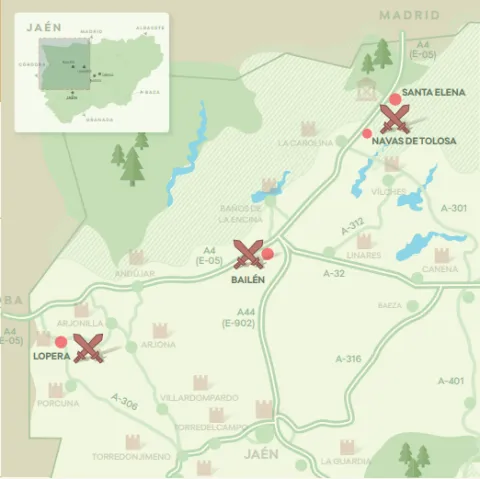
ROUTE FROM SANTA ELENA (LAS NAVAS DE TOLOSA) TO LOPERA

WAR MILESTONES THAT CHANGED THE COURSE OF HISTORY

This adventure takes travellers to the sites of the three most significant battles that took place on the lands of Jaén: Las Navas de Tolosa (1212), Bailén (1808) and Lopera (1936).

The first two were especially momentous, as they determined the fate of the rivals they pitted against each other: in the first case, the Kingdom of Castile against the Almohad Caliphate; and in the second, Spain against France. The third is remembered, among other things, for the tragic fate of the international brigade members who took part, including the English poet John Cornford (great-grandson of Charles Darwin) and the writer Ralph Winston Fox. "Battlefields" highlights the province's geographical position, which has historically made it a strategic stronghold from the time of the Roman conquest of Hispania — with the Battle of Baecula (currently under study) — right through to the Spanish War of Independence in the 19th century. All three battles have a museum or interpretation centre where visitors can learn first-hand about the historical and military background of each and their consequences.
imagen
Image
mapa ruta 2
Imagen principal
Desactivado
Puntos del trazado
Latitud
38.3402
Longitud
-3.5398
Latitud
38.2858
Longitud
-3.5867
Latitud
38.09679
Longitud
-3.77656
Latitud
37.94542
Longitud
-4.21463
Desactivado

Route card

Battle of Las Navas de Tolosa

Navas de Tolosa

THE GREAT CRUSADE ON THE PENINSULA

The Battle of Las Navas de Tolosa on 16 July 1212, in the province of Jaén, represents one of the great events of medieval history on the Iberian Peninsula, owing to its significance in the advance of the Christian kingdoms over Al-Andalus.

The conflict was conceived as a crusade — preached by Pope Innocent III — and pitted an army of men from the peninsular kingdoms and from beyond the Pyrenees, led by the Christian kings Alfonso VIII of Castile, Peter II of Aragon and Sancho VII of Navarre, against the forces of the Almohad Caliph Muhammad al-Nasir, whose army brought together fighters from the Maghreb, sub-Saharan territories and Turkish contingents. The confrontation proved vital for the territory's future, as the Almohad defeat at Las Navas de Tolosa marked the beginning of the definitive conquest of Al-Andalus by the Christian kingdoms of the peninsula. It is precisely in the Despeñaperros Natural Park, a short distance from where the battle took place, that the Museum of the Battle of Las Navas de Tolosa can be found, specifically in the town of Santa Elena. This space guides visitors through the history of the conflict, from its build-up to the decisive confrontation, using audiovisual displays and staged scenes, educational workshops, and visits to the battlefield and the Despeñaperros Natural Park. It is also a starting point and information hub for the Castles and Battles of the Kingdom of Jaén route.
Imagen

Battle of Bailén

Bailén

NAPOLEON'S FIRST MAJOR SETBACK

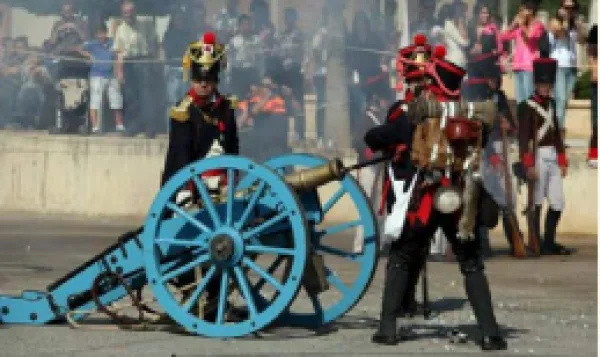
If there was one key moment in the later course of the War of Independence, it was the Battle of Bailén, on 19 July 1808, as it marked the first major defeat of the French imperial army against the Spanish side.

That day, Divisional General Pierre Dupont, after a long day of continuous, unsuccessful attacks — and with an army weakened by heat and lack of water — surrendered to the troops organised by the Captain General of Andalusia, Francisco Javier Castaños. The victory at Bailén had major consequences for the course of the war against the French, as it psychologically raised Spanish morale and, politically, supported the argument for the need to establish a single authority to lead the war. Militarily, it opened the way to Madrid, forcing Joseph I to withdraw to Vitoria. Thus began the first chapter of a war that would last until 1814. The Museum of the Battle of Bailén offers the chance to learn about this key episode in Spain's contemporary history and gain a historical overview of the War of Independence, through a journey through the six years of conflict and its consequences.
Imagen

Battle of Lopera

Lopera

THE BLOODY FRONTLINE BETWEEN TWO SIDES

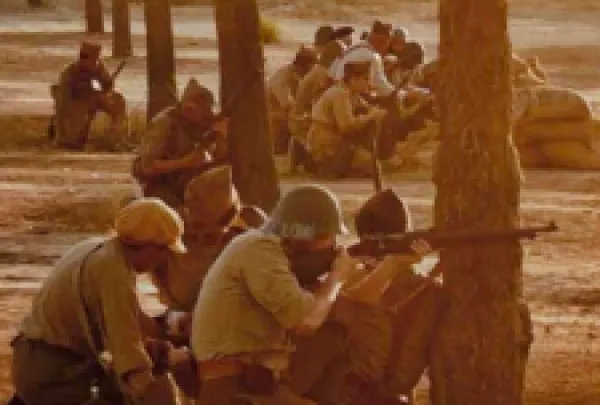
During the early stages of the Spanish Civil War, the province of Jaén became a vital territory for controlling the route towards the north of the peninsula.

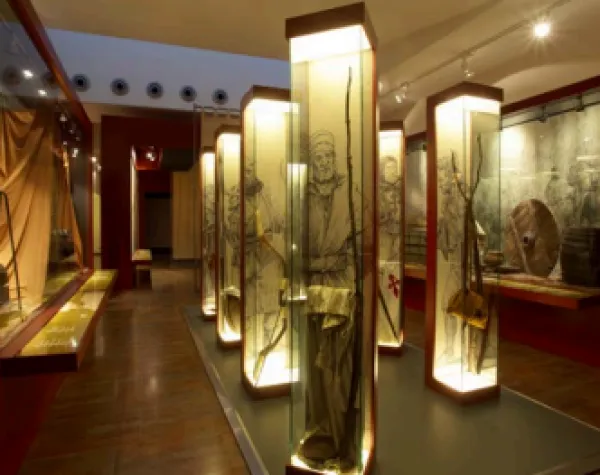
Lopera was one of the key towns in this reality, which kept Jaén on the front line for more than three years of conflict. In late 1936, the advance of the Francoist troops under Commander Redondo forced the Republican armies to block their path in the area around Porcuna and Lopera. In this latter town, the XIV International Brigade — led by General Walter, on the Republican side — clashed with the troops of Commander Redondo — on the side of the rebels. It was Christmas 1936. Because Lopera remained the dividing line between the two sides until the end of the war, visitors can find remains of trenches, machine-gun nests, bunkers, small forts, caves, shelters and more, scattered across the area. Lopera Castle houses a museum with an exhibition dedicated to the Civil War and to this battle.
Imagen

From Al-Andalus to the Renaissance

Submitted by brandcode_deweloper on
Breve descripción

ROUTE FROM SANTA ELENA TO SABIOTE

THE TRANSITION FROM AL-ANDALUS SOCIETY TO CASTILIAN SOCIETY

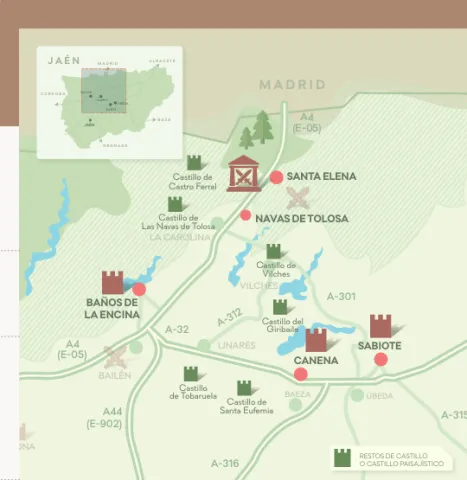
The journey enters the "Castles and Battles of the Kingdom of Jaén" route from the north, in an itinerary that begins at the Museum of the Battle of Las Navas de Tolosa (Santa Elena) and takes in some of the route's most spectacular castles, such as those of Baños de la Encina, Canena and Sabiote.

Visitors gain an overview of the historical process that led from Al-Andalus society to Castilian-Christian society; the story of a struggle for control of the territory between the peninsula's Christian kingdoms and Al-Andalus, with particular attention to the frontier between the Nasrid Kingdom of Granada and the Kingdom of Castile between the 12th and 16th centuries. Each stop offers a glimpse of a specific aspect. The Museum of the Battle of Las Navas provides a concise overview of the conflict, while Baños de la Encina offers the Muslim perspective and the organisation of Al-Andalus territory. Canena and Sabiote, meanwhile, represent the period following the conquest and the establishment of a new social, economic and cultural model that emerged under the feudal system prevailing in the conquered territories, thereby linking to the Renaissance.

imagen
Image
mapa ruta 1
Imagen principal
Desactivado
Puntos del trazado
Latitud
38.28561
Longitud
-3.58674
Latitud
38.1710
Longitud
-3.7744
Latitud
38.048
Longitud
-3.483
Latitud
38.06919
Longitud
-3.30681
Desactivado

Route card

Burgalimar Castle

Baños de la Encina

WITH THE SOUL OF AL-ANDALUS FORTRESSES

A defensive complex built in the 12th century and remodelled after the Christian conquest in 1225, it stood out for its enviable strategic position, controlling Sierra Morena to the north and the entire countryside of Jaén to the south.

This fortress is undoubtedly one of the main reasons Baños de la Encina has been included in the "Most Beautiful Villages of Spain" network. This defensive complex was built before the military events that culminated in the Battle of Las Navas de Tolosa (1212), serving as a defensive stronghold, alongside the castles of Castro Ferral, Las Navas de Tolosa and Vilches, against the advance of Christian troops led by their monarchs, most notably Alfonso VII and Alfonso VIII.

It is a walled Muslim fortress built in tabiyya (rammed earth) technique, with an elliptical shape, featuring an alcazar and an outer enclosure marked by 14 square towers and a Keep (Torre de Homenaje). Following its conquest by Ferdinand III of Castile in 1225, the castle and its defensive system underwent internal reorganisation. In the northern area, the Alcazarejo was built, featuring a circular tower and two ashlar walls attached to the castle's original Muslim ramparts.

The Lasting Legacy of Francisco de los Cobos

This transformation of life in these territories towards the Renaissance, reflected architecturally in castles such as those of Sabiote and Canena, is closely linked to Francisco de los Cobos, private secretary and Secretary of State to Charles I, whose high administrative standing led him to accompany the emperor on his expeditions to Germany, Italy and Berbería. In the case of the Canena fortification, De los Cobos commissioned Andrés de Vandelvira to build it after acquiring the entire town in 1539. In the case of Sabiote, following its acquisition in the late 15th and early 16th centuries, he hired the architect to transform the original fortress into a majestic Renaissance palace. 

Other Must-See Visits 

Other unmissable stops for the unhurried, patient traveller include the picturesque castles of Castro Ferral in Santa Elena, Las Navas de Tolosa in La Carolina, Vilches and Giribaile, or Tobaruela and Santa Eufemia in Linares.

Imagen

Canena Castle

Canena

A FASCINATING EXAMPLE OF MILITARY-PALATIAL ARCHITECTURE

An elegant and outstanding example of Renaissance architecture in its own right, bearing the mark of one of the great masters of this artistic movement in Andalusia: Andrés de Vandelvira.

The complex combines military elements — such as the circular towers, the moat and the loopholes defending its main entrance — with purely decorative ones, such as the Plateresque doorway, the gallery opening onto the south side, or the Renaissance-style courtyard. During the Islamic period, Canena was a small fortified settlement (hisn), but around 1226 this territory fell into Castilian hands, giving rise to an extraordinary situation: it was divided between the military orders of Santiago and Calatrava, splitting the village into two "quarters" under different jurisdictions that coexisted for more than a century and a half. In the 16th century, Francisco de los Cobos, secretary to Charles I, acquired the town and commissioned the renowned Andrés de Vandelvira to build a fortified palace. It is a rectangular, compact and austere building. The southeastern side, where the entrance is located, is protected by two cylindrical towers positioned at its corners, as well as by a moat.

Sabiote Castle

Sabiote

FROM FORTRESS TO MAJESTIC RENAISSANCE PALACE

In the heart of the charming Albaicín district — the town's oldest quarter, which still preserves its medieval network of narrow streets, small squares and dead-end alleys — stands the dazzling fortress of Sabiote.

It is considered one of the most important military structures in Andalusia. This castle originated as a small fortified Emirate/Caliphate settlement, which was demolished to make way for a solid castle built by the Order of Calatrava. Its later acquisition by Francisco de los Cobos, in the late 15th and early 16th centuries, brought about its final transformation, as he commissioned Andrés de Vandelvira to renovate the castle and turn it into a majestic Renaissance palace arranged around a colonnaded courtyard. Seven solid towers make up the structure of Sabiote Castle, the most notable being the great Keep (Torre del Homenaje). Vandelvira worked on both the interior spaces and the defensive systems, enhancing the residential function with new palace wings reaching four storeys and altering the access points into the fortress. Inside, new rooms were created around a large colonnaded courtyard, with arches resting on columns.

Imagen