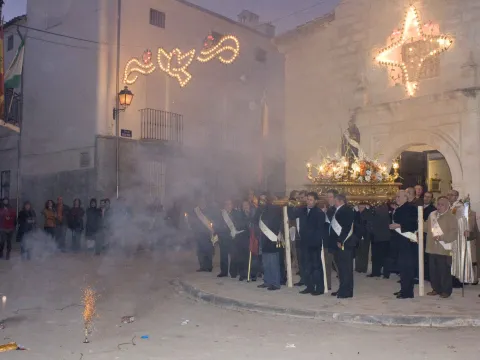
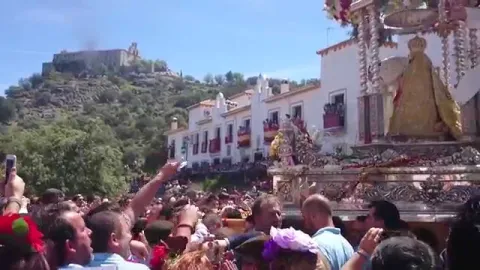
Feria y Fiesta en honor a Nuestro Padre Jesús Nazareno
Held in the hamlet of Ventas de Carrizal.
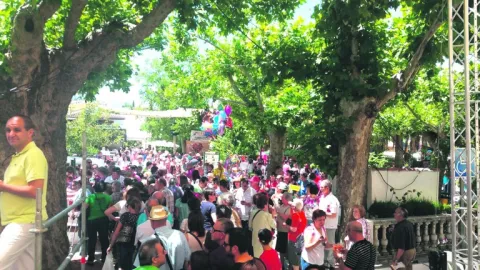
Held since 1983, this festival has given a major boost to tourism and gastronomy in the town. Among the many activities organised is a free tasting of various products based mainly on cherries.
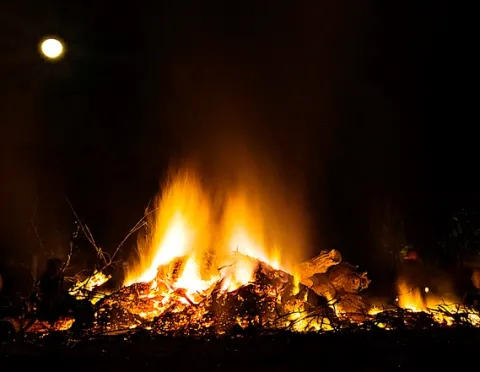
After the religious ceremony, the festive events are usually centred around a bonfire, with food and drink shared around it, contributed by everyone who gathers at the site of the bonfire.
During this celebration, young people usually "jump over the fire".
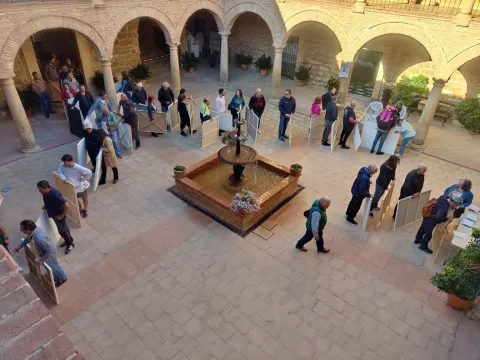
This is one of the main hallmarks of a Castillo de Locubín town. The competition welcomes visual artists from every corner of Spain and beyond. It is one of the most prestigious in Andalusia and one of the three most important of its kind at national level.
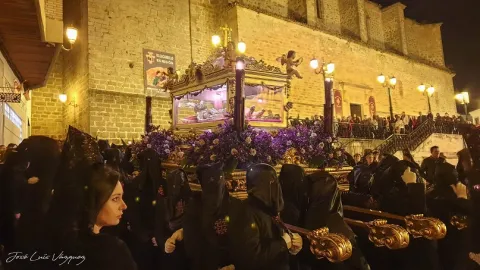
Holy Week in the province of Jaén preserves its history, tradition, art and popular religion. Its brotherhoods and confraternities hold a rich and precious legacy, an essential part of the province's Artistic and Cultural Heritage. It combines Castilian restraint with, on the other hand, Andalusian splendour. The majesty and beauty of the sculptural quality of its religious imagery are also remarkable.
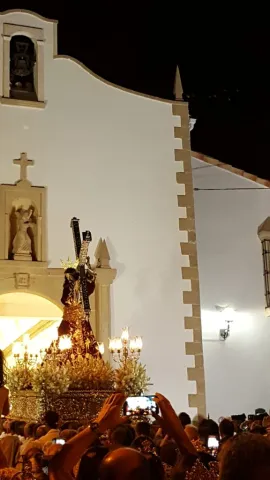
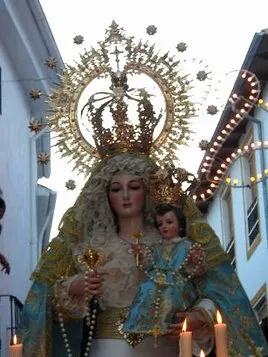
Throughout the festival, several processions carry the image of the patron saint through the town's streets; the first of these includes the opening skirmishes between Moors and Christians. Bull runs are also held ("la vaquilla del aguardiente").
On the first night, an event is held in the main square to choose the festival queen and her maids of honour.
Sack races, essay and drawing competitions, dance contests, ribbon races on horseback, donkey races, log-cutting, tug of war, greasy poles, a swimming competition and a marathon from Carchelejo to Cárchel are all held.
A floral offering is made to the patron saint, using bouquets provided by the town hall.
A parade of giants and big-heads takes place.
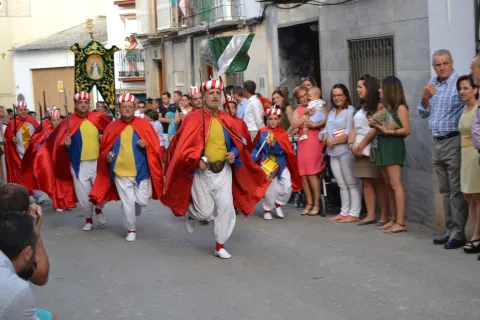
The Moors and Christians performance re-enacts the following scene:
After several unsuccessful attempts, the image of the Virgin is captured by the Moorish army during the procession on the afternoon of the 14th and taken to the castle, built of wood for the occasion in the square. In the morning, the Christians attempt to storm the castle, but fail; it is then that the Christian king sends an embassy that argues with the Moor over the Christian religion and the Virgin, ending in a fresh skirmish and victory for the Christians. The costumes are brightly coloured, with those of the Christian army particularly striking, adorned with bunches of flowers on their hats.
The mock battles between the armies are also curious, featuring movements reminiscent of old stick-dance traditions.
During the performance, numerous shotgun shots are fired, and at the end, the couples pass by the Virgin's platform, still inside the castle, and once at the top, with shotguns in both their hands, they fire a few rounds into the air.
Where does the origin of the Moors and Christians Festivities lie, and its connection with the Virgen del Rosario in Carchelejo?
The feast of the Virgen del Rosario was established at the request of Pope Gregory XIII, to commemorate the naval victory won over the Turks by the Christian fleet at the Battle of Lepanto on 7 October 1571. That Christian fleet sailed under the patronage of the Virgen del Rosario, as shown on the standard preserved in the National Naval Museum.
Several theories can be put forward regarding the origin of these Moors and Christians festivities. On one hand, there is the deep-seated warlike sentiment reflecting the historical vicissitudes of border towns that lived for 250 years alongside the Muslims of Granada (as in the case of Carchelejo, Campillo de Arenas and Bélmez de la Moraleda).
On the other hand, we must consider the basic association made by ordinary people between victory and supernatural intervention, aligning the Moors and Christians re-enactments with the patron saint's festivities. This coincidence may stem from the periodic training that local militias had to carry out, which over time came to coincide with the patron saint festivities, days on which farm work was set aside and used instead for military drills.
The earliest documentary records of the Brotherhood of Nuestra Señora del Rosario de Carchelejo date back to 1751 and are recorded in the Cadastre of the Marqués de la Ensenada. The brotherhood was obliged each year to hold 4 plain festivals, 16 festivals with procession, and “one festival with procession, priest, sacristan and sermon”. This last one was likely the brotherhood's main festival.
The text of Las Embajadas, full of familiar tropes, doctrinal references and historical allusions, blends together various events being commemorated, such as the aforementioned Battle of Lepanto, the struggles against Protestants and Jews, and above all the struggle of Catholic Christianity, deeply embedded in the social mindset and popular tradition, combined with religious doctrine, reflected in the act of affirming faith in the mysteries of the Trinity and the Virgin's virginity. The rest consists of updates and additions that oral tradition itself has continued to incorporate as Spanish history has unfolded — such as references to Ferdinand VII, once the War of Independence had ended, or to nationalist Christians. I cannot determine the exact origin of these Moors and Christians festivities in Carchelejo, but it is likely that the combination of devotion to the Virgen del Rosario, the brotherhood's obligation to hold annual festivals, and the aforementioned military references gave rise to today's festival. This leads us to reflect that traditions are, and should always be, ever-changing — otherwise, a moment may come when the reason or basis behind the festivities is no longer understood, and the dialogues and texts become fossilised to the point of becoming incomprehensible.
This change shows that the tradition remains alive and fresh, carried forward by the people who create and live it, and will therefore never die.

Held on 17 January, this is one of the few festivals that has not moved to summer, perhaps because that season already features the festival of the Virgen del Rosario, the town's other patron saint. There's a saying in the region reflecting this devotion: “San Antón en Cárcel, llueva o rabie” ("San Antón in Cárcel, come rain or shine"). Bonfires are lit the night before, in the streets, around which residents gather until the early hours of the morning. Today, the tradition of the “Cochinillo de San Antón” has been revived, a piglet raised collectively by all the town's residents.
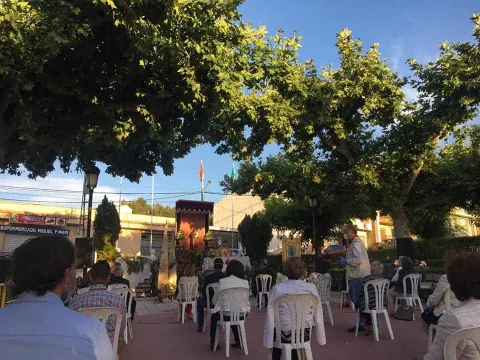
The night-time festival, with dancing held in Calle del Pilar, around a small altar to the Saint located between a shop and a bar.
It was previously held in Calle San Antonio, which still exists today.
Mothers used to accompany their daughters to the dance, keeping an eye on their behaviour.
Various competitions are held, including one for façade decoration.
San Antonio, besides being a matchmaking saint, is also considered very helpful for finding lost items, said to reappear once he is invoked.
This festival, once lost, is organised by the cultural association La Mezquita (now defunct) of Carchelejo, which, during its years of operation, carried out significant work reviving the town's old festivals.