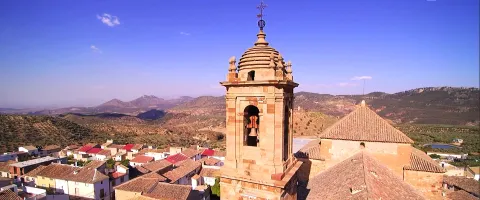
With the arrival of Easter in Cambil, a period of religious events and traditional customs begins, filling our town with the scent of incense.
It is curious to see the escort given to Christ by the Roman soldiers, here called the “armaos”, who spend a whole day not leaving the church, eating the traditional “bacalao encebollao” in the sacristy, and where it was once customary for the priest and choirmaster to sing the “Sermón de Madrugada” on Good Friday, made up of the “Confortación del Ángel”, “la Sentencia de Pilatos” and the text of “El Cronista”.
The following events and processions can be enjoyed:
It begins with the imposition of ashes on «Ash Wednesday«, when young and old alike attend church, marking the start of the events preparing us to experience the Passion and Death of Jesus of Nazareth.
Friday of Sorrows: Although nowadays the venerated image of the Virgen de Dolores is not carried in procession, in previous decades the carving of Nuestra Señora de los Dolores was indeed carried, a carving dating from the early 20th century, now located in the right-hand chapel of the church, alongside San Juan and Jesus on the Cross.
Palm Sunday: With the blessing of olive branches and palm fronds, a procession makes its way through the streets of Cambil, just as Jesus once did upon his entry into Jerusalem. The Eucharist is then celebrated at the Church of Nuestra Señora de la Encarnación, marking the start of Holy Week in Cambil.
On Monday, religious activities are held at the parish church.
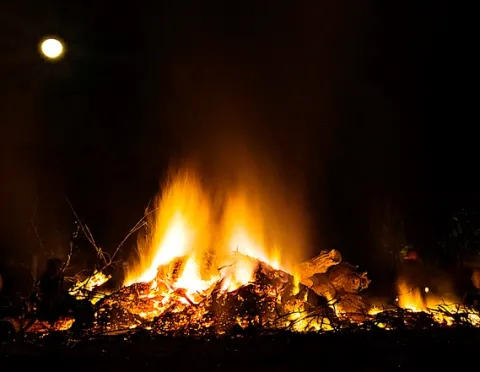
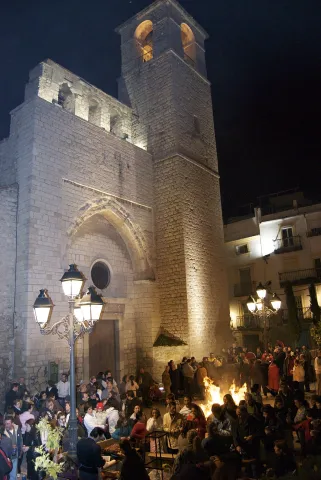
Holy Tuesday: Close to dawn, the image of Christ on the Cross is accompanied along a Way of the Cross that passes through the town's neighbourhoods. With the penitential stations, Christ pauses to recall the journey from his arrest to his death on the Cross. Fires lit by residents illuminate the way of this processional retinue. In a silence broken only by the words of those reading the penitential stations and by prayers, these are the only sounds giving way to the most representative events of Holy Week in Cambil.
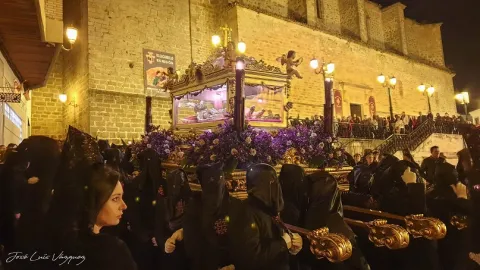
Holy Wednesday: Procession of the Cristo del Perdón, the procession of Christ bound to the column, follows the official route.
Holy Thursday: At six in the evening, the Eucharist begins, marking the start of Christ's final hour. After the liturgical events, the procession of El Cautivo, San Juan and the Virgen de los Dolores follows the official route — the same route followed by all subsequent processions, except that of Nuestro Padre Jesús, which passes through the Plaza de la Moraleda.
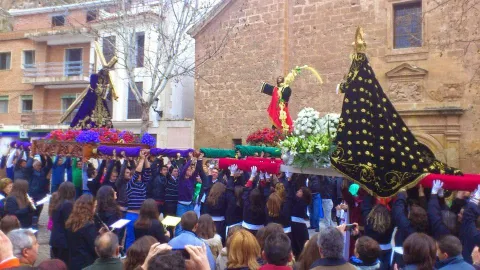
Early hours: the «Sentencia de la Muerte de Cristo», sung by the men of Cambil, in a moving act of faith, sends Jesus of Nazareth to his death on the cross. Nuestro Padre Jesús Nazareno then processes, followed by San Juan and the Virgen de los Dolores. Worth noting is «el encuentro» (the meeting) that takes place in the Plaza de la Constitución between the three images, a heartfelt moment bringing Cambil together with Jesus, his friend, and his mother.
Good Friday: At five in the morning, wooden ratchets announce the Holy Offices of Jesus. With the death of Christ, his offices begin, followed by the procession of the Santo Sepulcro, Jesus on the Cross (Cristo de la Misericordia), San Juan and the Virgen de los Dolores. The Virgin Mary sets out at eleven at night in what is known as the «Procesión de la Soledad», in which Cambil bears witness to the grief of a mother who has lost her son.
Holy Saturday: At eleven at night, the preparatory events begin, culminating in Jesus's victory over death. Glory Saturday marks Jesus's triumph over death, symbolised by the bonfire and the light of candles lit from a fire, whose ashes are kept so that the following year's «Ash Wednesday« can be celebrated once again.
Easter Sunday: After the Eucharist, a procession is held with the image of the Risen Christ, bringing to a close the religious events held in Cambil for Holy Week.
In the hamlet of Arbuniel, the «Encuentro« (Meeting) stands out, a procession dramatising the passing of San Juan, the Virgin and the Risen Christ.